Quiz Entry - updated: 2026.07.30
What are the special-use IPv4 addresses: loopback and link-local?
Loopback (127.0.0.0/8, usually 127.0.0.1) tests the local TCP/IP stack; link-local/APIPA (169.254.0.0/16) is self-assigned when no DHCP server answers.
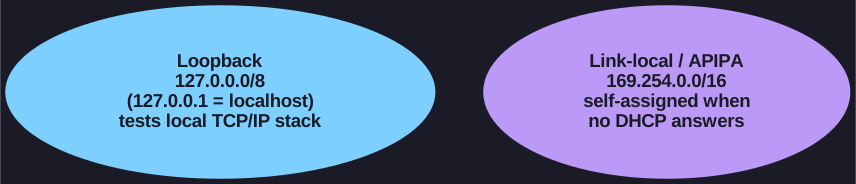
* Loopback tests the local stack; link-local self-assigns when DHCP is absent. *
Special-Use IPv4 Addresses:
| Type | Range | Purpose |
|---|---|---|
| Loopback | 127.0.0.0/8 (127.0.0.1 most common) | Test TCP/IP stack on local host |
| Link-Local (APIPA) | 169.254.0.0/16 | Auto-assigned when DHCP fails |
Loopback Address (127.0.0.1):
- "localhost" - refers to the local machine itself
- Used to test if TCP/IP is working on the device
- Packets never leave the host
ping 127.0.0.1tests the local IP stack
Link-Local / APIPA (169.254.x.x):
- Automatic Private IP Addressing
- Windows/other OS auto-assigns when no DHCP server responds
- Allows communication with other APIPA hosts on same LAN
- Cannot communicate beyond local network
- Indicates a DHCP problem if you see this address
Go deeper:
 RFC 3927 — Dynamic Configuration of IPv4 Link-Local Addresses (IETF) — the standard behind 169.254.0.0/16 / APIPA.
- Link-local address (Wikipedia) — the 169.254.0.0/16 range and APIPA self-assignment.
- localhost & the loopback (Wikipedia) — 127.0.0.0/8, 127.0.0.1 and the loopback interface.