What are the stages of ISO's standardisation process, and which acronyms are used at each stage?
A new ISO standard climbs through nine stages: PWI → NWIP → WD → CD → DIS → FDIS → IS → (review/withdrawal). Each stage requires committee approval to advance.
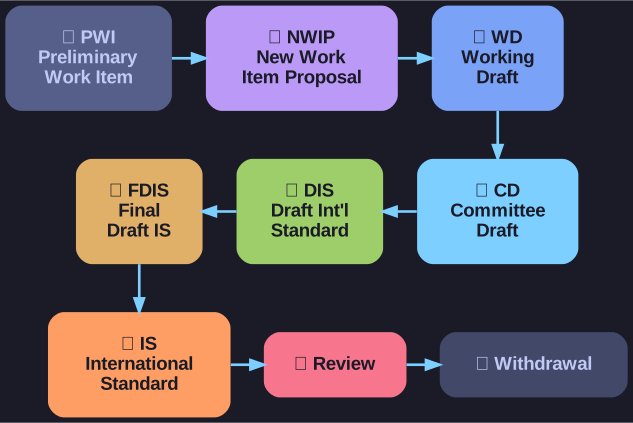
* ISO's nine-stage pipeline: a proposal climbs from PWI through committee ballots to a published International Standard, then Review and eventual Withdrawal. *
| Stage | Code | Name | English term |
|---|---|---|---|
| 00 | PWI | Vorstadium (Vorläufiges Projekt) | Preliminary Work Item |
| 10 | NWIP | Vorschlag (Normenantrag) | New Work Item Proposal |
| 20 | WD | Vorbereitung (Arbeitspapier) | Working Draft |
| 30 | CD | Komiteephase (Komiteeentwurf) | Committee Draft |
| 40 | DIS | Prüfung (Entwurf) | Draft International Standard |
| 50 | FDIS | Zustimmung (Schlussentwurf) | Final Draft International Standard |
| 60 | IS | Veröffentlichung (Internationale Norm) | International Standard |
| 90 | — | Überprüfung | Review |
| 95 | — | Rückzug | Withdrawal |
Each major stage transition needs a member ballot (countries vote yes / no / abstain). A standard typically takes 3–5 years from PWI to IS; new revisions (e.g., 27001:2013 → 27001:2022) follow the same cycle.
Tip: The "stage" of a standard tells you how stable it is. Procuring against a DIS is risky — text can still change before publication. Building against an IS gives you 5+ years before the next major revision.
Go deeper:
 ISO standardization stages (Wikipedia) — the full PWI to NWIP to WD to CD to DIS to FDIS to IS pipeline with each stage's abbreviation.