Quiz Entry - updated: 2026.07.30
What are the steps in the DHCPv6 (Dynamic Host Configuration Protocol version 6) message exchange process?
The host first does SLAAC (Stateless Address Autoconfiguration) (RS (Router Solicitation)/RA (Router Advertisement)), then if directed, performs a DHCPv6 exchange: SOLICIT → ADVERTISE → REQUEST/INFORMATION-REQUEST → REPLY.
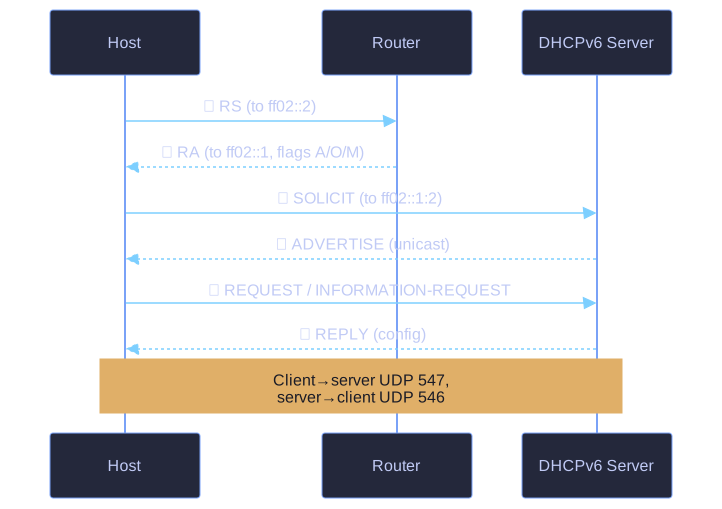
* DHCPv6 exchange with router discovery. *
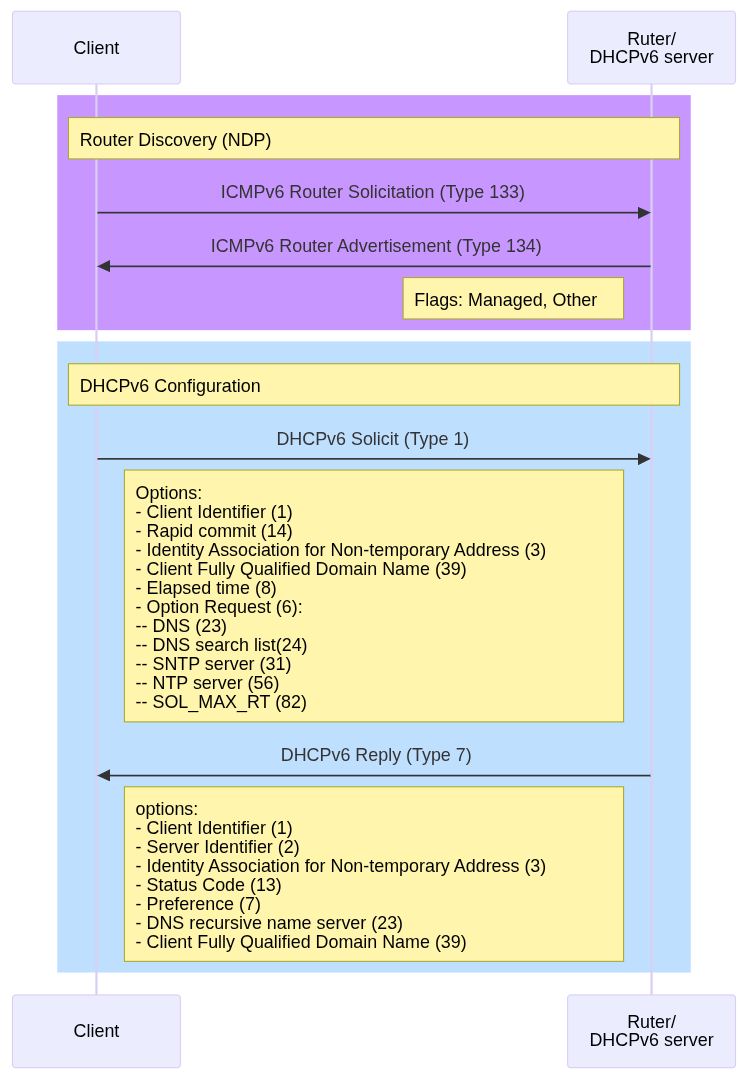
* DHCPv6 exchange with router discovery. — EidenNor, CC BY-SA 4.0, via Wikimedia Commons. *
Full process (6 steps):
| Step | Message | Direction | Purpose |
|---|---|---|---|
| 1 | RS | Host → All routers (ff02::2) | Request router information |
| 2 | RA | Router → All nodes (ff02::1) | Provide prefix + flags (A, O, M) |
| 3 | SOLICIT | Host → All DHCPv6 servers (ff02::1:2) | Find DHCPv6 servers |
| 4 | ADVERTISE | Server → Host (unicast) | Server offers its services |
| 5 | REQUEST or INFORMATION-REQUEST | Host → Server (unicast) | Request address or just info |
| 6 | REPLY | Server → Host (unicast) | Server provides requested config |
Important port numbers:
- Client to server: UDP (User Datagram Protocol) port 547
- Server to client: UDP port 546
Key difference from DHCPv4 (Dynamic Host Configuration Protocol version 4):
- DHCPv4 uses DORA (Discover, Offer, Request, Acknowledge)
- DHCPv6 uses SARR-like flow but with different names and always starts with the SLAAC RS/RA exchange
- Step 5 uses REQUEST for stateful (getting an address) or INFORMATION-REQUEST for stateless (just getting DNS (Domain Name System) etc.)
Go deeper:
 DHCPv6 (Wikipedia) — the message-type table (SOLICIT/ADVERTISE/REQUEST/REPLY), ports 546/547, stateful vs stateless.
- RFC 8415 §5 — DHCPv6 exchanges — the canonical four-message and Information-request exchanges.