What are the three categories of attacks on RSA, and which is not about breaking the math?
Protocol attacks (misuse), mathematical attacks (factoring n), and side-channel attacks (leak the key from the hardware). Side-channel attacks don't touch the math at all.
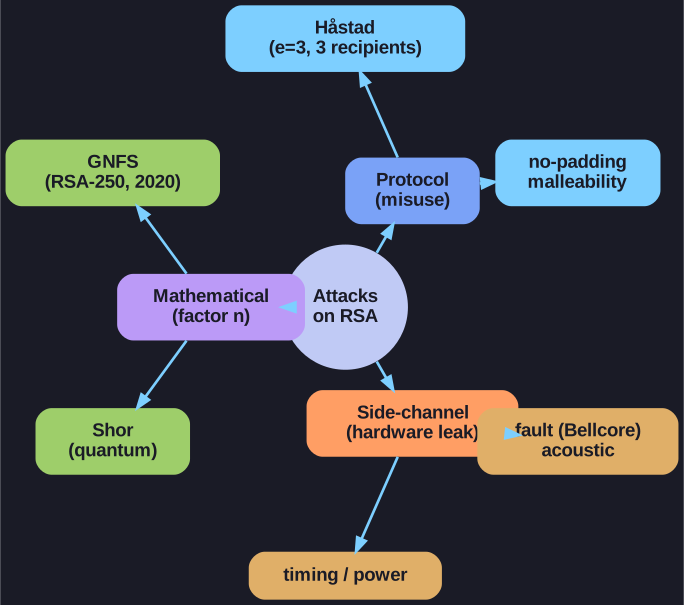
* The three attack families — only the Mathematical branch attacks factoring itself; Protocol and Side-channel bypass the unbroken math. *
1. Protocol-level attacks — exploit how RSA is used, not the algorithm itself.
- Textbook RSA (no padding) is malleable:
c · k^e mod ndecrypts tom·k. Always use OAEP padding for encryption, PSS for signatures. - Small public exponent + no padding: if Alice sends the same
mto 3 recipients usinge=3, you can recovermvia the Chinese Remainder Theorem (Håstad's attack). - Reusing the same modulus across users (common modulus attack).
2. Mathematical attacks — factor n directly.
- General Number Field Sieve (GNFS) is the best-known classical algorithm. The current factoring record is RSA-250 (~829-bit number), factored in 2020.
- For each new factoring record, the recommended RSA key size goes up. 1024-bit RSA is considered broken for governments; 2048 is being phased out; 3072+ is current best practice.
- Quantum: Shor's algorithm factors any size
nin polynomial time on a sufficiently large fault-tolerant quantum computer. Such a computer doesn't yet exist, but post-quantum crypto is being deployed pre-emptively.
3. Side-channel attacks — read the key from physical leakage during decryption.
- Power analysis (SPA/DPA) on smart cards: the squaring-vs-multiplying pattern of the exponentiation leaks bits of
d. Defense: constant-time exponentiation + blinding. - Timing attacks on networked TLS servers (Kocher 1996): the time to decrypt depends on
d, leaking bits over many requests. - Fault injection (e.g. glitching the CPU's voltage): the Bellcore attack uses a single faulty CRT computation to factor
n. - Acoustic (Genkin, Shamir, Tromer 2014): extract 4096-bit RSA key from a laptop's coil whine, from across the room, in under an hour.
Tip: "The math is unbroken" ≠ "RSA is safe to deploy." Most real-world RSA failures are protocol or side-channel issues, not factoring. Use a well-vetted library (OpenSSL, libsodium), use OAEP/PSS, never roll your own.
Go deeper:
 Side-channel attack (Wikipedia) — the timing/power/acoustic leaks that break implementations without touching the math.
- Twenty Years of Attacks on the RSA Cryptosystem — D. Boneh — the classic survey classifying RSA attacks into protocol/math/implementation.