Quiz Entry - updated: 2026.07.30
What are the three components of a Bridge ID (BID), and what are their default values?
The BID consists of Bridge Priority (default 32768), Extended System ID (VLAN (Virtual Local Area Network) number), and the switch's MAC (Media Access Control) address.
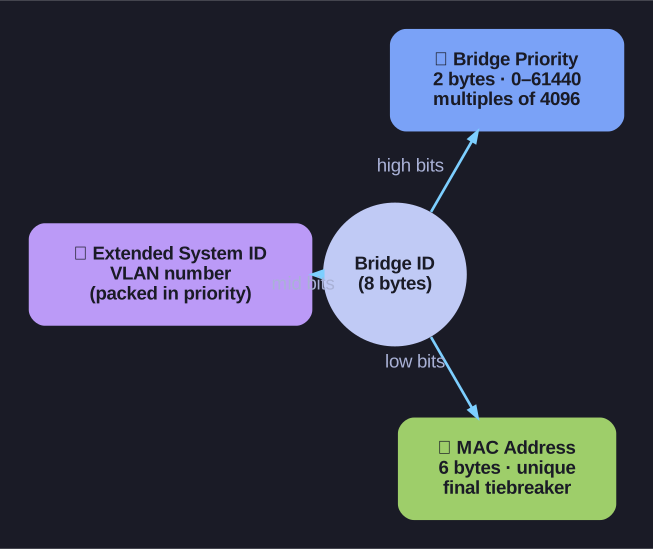
* How two Bridge IDs are compared. *
| Component | Details |
|---|---|
| Bridge Priority | Default: 32768. Range: 0–61440, in increments of 4096. Lower = better. |
| Extended System ID | Added to the bridge priority to identify the VLAN for this BPDU (Bridge Protocol Data Unit). |
| MAC Address | The switch's hardware address. Used as the final tiebreaker. |
How root bridge election works:
- Compare priority first — lowest wins
- If priority is tied, compare extended system ID
- If still tied, the lowest MAC address (in hexadecimal) wins
Why increments of 4096? The original 16-bit priority field was split: the upper 4 bits are the configurable priority (giving 16 possible values × 4096 = 0 to 61440), and the lower 12 bits hold the VLAN ID (the extended system ID).
Tip: On Cisco switches, you'll often see a BID priority of 32769 — that's 32768 (default priority) + 1 (VLAN 1).
Go deeper:
 Spanning Tree Protocol — Bridge ID (Wikipedia) — the 64-bit BID split into priority, 12-bit extended system ID and MAC, and why priority steps by 4096.