Quiz Entry - updated: 2026.07.30
What are the three fundamental routing table principles that every network administrator must understand?
1) Every router makes its own independent decision based only on its own routing table. 2) A route in one router's table doesn't mean other routers know the same route. 3) A route to a destination doesn't guarantee a return path exists.
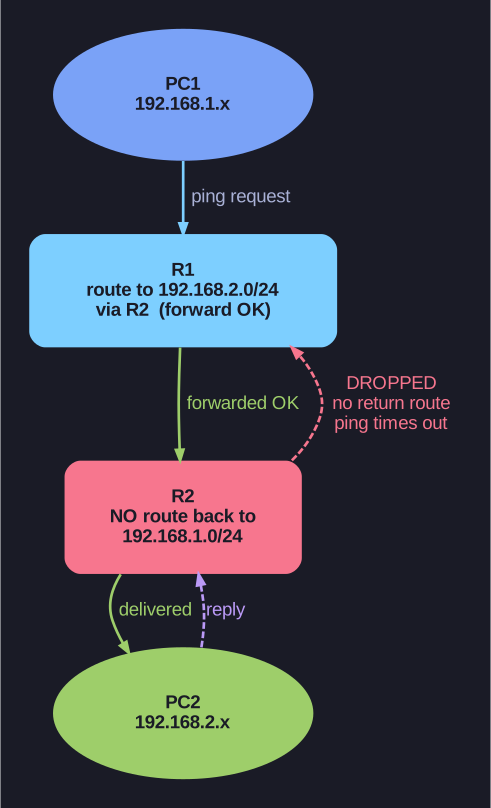
* The return-route problem. *
| Principle | Explanation | Common Mistake |
|---|---|---|
| Independent decisions | R1 forwards based on R1's table only. R1 has no knowledge of R2's routing table | Assuming R1 "knows" the full path to the destination |
| Tables don't sync automatically | R1 having a route to 10.0.0.0/8 via R2 doesn't mean R2 has that route, or that R2 knows how to reach it | Adding a route on R1 and forgetting to add the corresponding route on R2 |
| No guarantee of return path | R1 knows how to forward a packet TO 10.0.0.0/8, but that doesn't mean the destination knows how to send a reply BACK | One-way connectivity — ping fails because the return route is missing |
The return route problem (most common static routing mistake):
R1 has: ip route 192.168.2.0 255.255.255.0 10.0.0.2     ✓ Forward works
R2 has: ??? (no route back to 192.168.1.0/24)             ✗ Return fails!
- PC1 (on 192.168.1.0) pings PC2 (on 192.168.2.0)
- R1 forwards the ping to R2 ✓
- R2 receives the ping, PC2 replies
- R2 tries to send the reply back to 192.168.1.0 — but has no route → drops it!
- Result: ping timeout even though the forward path works perfectly
Tip: Always verify routing in both directions. For every static route you add, ask: "Does the other end know how to get back?"