Quiz Entry - updated: 2026.07.30
What are the three pillars (required properties) of a zero-knowledge proof?
Correctness (also called completeness), Soundness, and Zero-Knowledge.
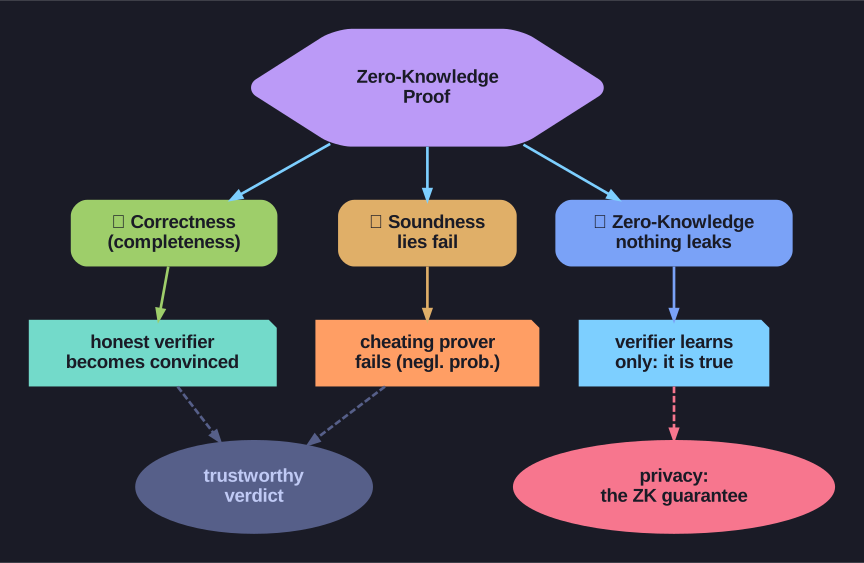
* The three pillars of a ZKP: correctness and soundness make the verdict trustworthy; zero-knowledge gives privacy. *
| Pillar | Plain meaning |
|---|---|
| Correctness (formally, completeness) | If the statement is true and the prover is honest, the honest verifier ends up convinced. |
| Soundness | If the statement is false, no cheating prover can convince the verifier (except with negligible probability). |
| Zero-Knowledge | The verifier learns nothing beyond the truth of the statement — no part of the secret leaks. |
Memory aid: Correctness = "truth convinces," Soundness = "lies fail," Zero-Knowledge = "nothing leaks."
The first two guarantee the verdict is trustworthy (a true claim is accepted, a false one rejected); the third is the privacy guarantee that makes it a zero-knowledge proof rather than an ordinary one. (Many textbooks name the first pillar completeness — the two terms mean the same property.)
Go deeper:
 Zero-knowledge proof — Definition (Wikipedia) — completeness, soundness and zero-knowledge with the conditions behind each.