Quiz Entry - updated: 2026.11.05
What are the three ways the police use DNA traces in investigations, and how do they differ?
Confirming a suspect (narrow context), searching databases for a known offender (extended context), and building a profile of an unknown offender (open context). The wider the context, the weaker the evidence and the greater the ethical risk.
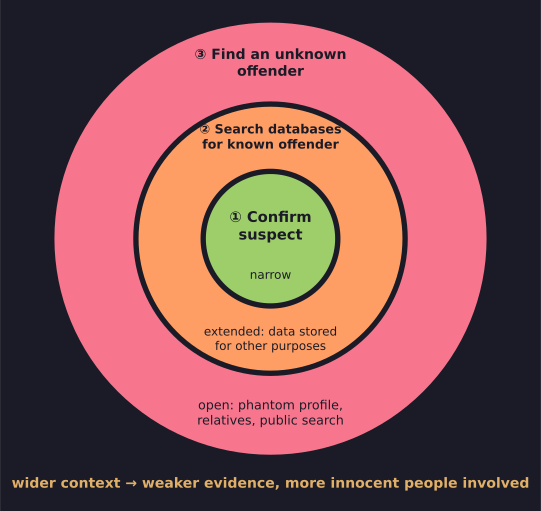
* The three DNA contexts: each wider ring involves more people who are not suspected of anything *
| Use | Steps | Strength |
|---|---|---|
| 1. Confirm a suspect (narrow context) | DNA from the crime scene is compared with DNA taken from the suspect. | Very high evidential value. |
| 2. Find a "known" offender (extended context) | The crime-scene DNA is matched against DNA stored in databases, including ones collected for other purposes (zweckfremd). | High value if there is a hit. |
| 3. Find an "unknown" offender (open context) | A "phantom profile" of the likely offender's traits is built from the DNA, databases are searched for relatives, and a public dragnet search is run with the virtual profile. | Only probabilistic; many innocent people come under suspicion. |
The ethical problems grow from step to step. Step 1 concerns only the suspect, while steps 2 and 3 pull in people who are not suspected of anything: those whose DNA was stored for another reason, their relatives, and everyone who happens to share the predicted traits.
Go deeper:
 Wikipedia: DNA profiling — how profiles are built, matched and stored in databases.