What are the two legal grounds for a person search outside criminal proceedings — Notsuche and Fahndung — and how do they differ?
Notsuche (Art. 35 BÜPF) lets the authority surveil telecom traffic to find a missing person who is in serious danger; Fahndung (Art. 36 BÜPF) lets it surveil to find an already-convicted person evading an enforceable custodial sentence. Both are explicitly possible outside a criminal investigation.
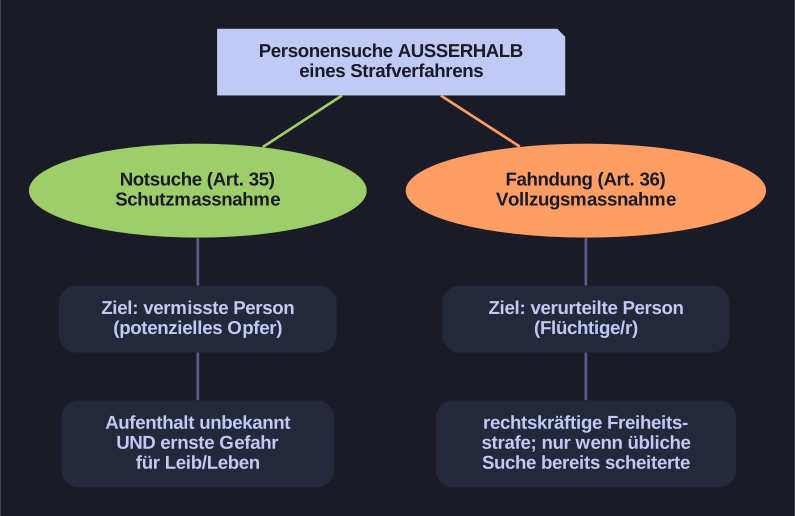
* Notsuche schuetzt das Opfer (Art. 35), Fahndung vollzieht ein Urteil (Art. 36). *
Notsuche (emergency search, Art. 35 BÜPF) exists to find a missing person. A person counts as missing only when two conditions hold together: their whereabouts are unknown or disproportionately hard to establish, and there are concrete indications of a serious danger to their health or life. This is a protective measure — the target is a potential victim, not a suspect — which is why the trigger is danger, not wrongdoing.
Fahndung (manhunt for convicted persons, Art. 36 BÜPF) exists to find someone against whom a final and enforceable custodial sentence (or liberty-depriving measure) has already been ordered. It is allowed only once ordinary search efforts have failed, or where a search without surveillance would be hopeless or disproportionately hindered. This is an enforcement measure — the target is a convicted fugitive, not a fresh suspect.
What ties them together is that both let the police use telecom localisation outside an ongoing criminal case: one to save an endangered person, the other to enforce an existing judgment. Because neither target is the subject of a live investigation, normal investigative powers do not reach them — which is exactly why each needs its own explicit statutory basis.
Tip: Notsuche = "find the endangered" (Art. 35, victim); Fahndung = "find the convicted" (Art. 36, fugitive). Both operate outside a criminal proceeding.
Go deeper:
 Post & telecom surveillance — procedure (li.admin.ch) — surveillance for emergency searches (missing persons) and tracing of convicted individuals.