Quiz Entry - updated: 2026.07.30
What are the two main forwarding methods used by switches?
Store-and-forward switching (receives the entire frame before forwarding) and cut-through switching (forwards immediately after reading the destination MAC (Media Access Control) address).
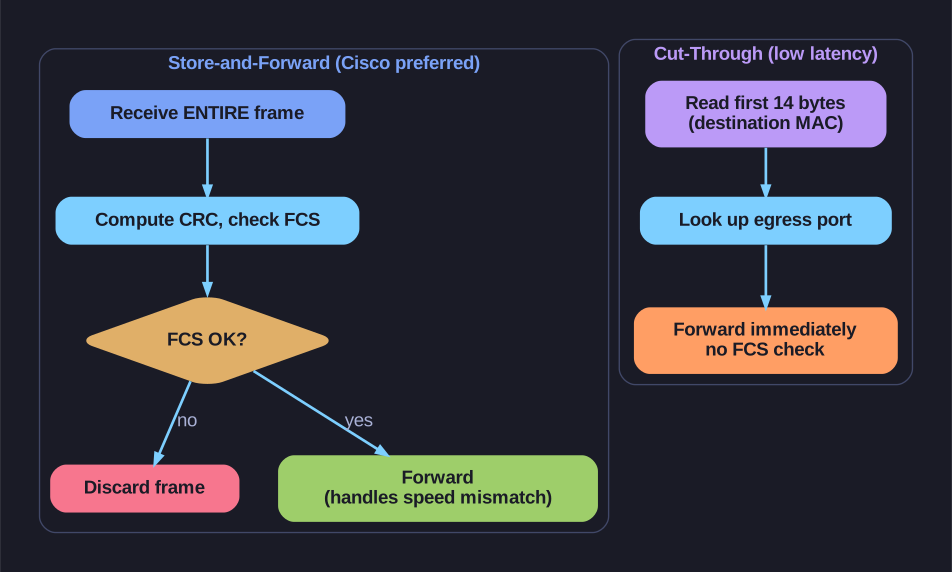
* Store-and-forward vs cut-through. *
| Feature | Store-and-Forward | Cut-Through |
|---|---|---|
| Reads | Entire frame | Only up to the destination MAC (first 6 bytes) |
| Error checking | Yes (checks FCS (Frame Check Sequence)/CRC (Cyclic Redundancy Check)) | No |
| Latency | Higher (must buffer whole frame) | Very low (< 10 μs possible) |
| Speed mismatch | Handles different port speeds | Cannot handle different speeds |
| Cisco preferred? | Yes | No (used for low-latency needs) |
Both methods use ASICs (Application-Specific Integrated Circuits) for hardware-accelerated switching decisions, which is why switches are so much faster than software-based routing.
Go deeper:
 Switch Speeds and Forwarding Methods (Cisco Press) — store-and-forward vs cut-through (fast-forward, fragment-free) and buffering.
- Store-and-Forward vs Cut-Through (NetworkAcademy.IO) — side-by-side latency/error-checking comparison with the verifying CLI.