What are the two types of media access control methods?
Contention-based access (nodes compete for the medium in half-duplex) and controlled access (each node gets a deterministic turn).
A media access control method is the rule that decides who is allowed to transmit when several devices share one medium. The two families take opposite approaches. Contention-based access is "listen and grab" — any node may try to send, so it is simple and efficient under light load, but two nodes can transmit at once and collide. Controlled access is "take turns" — a node may only send during its allotted slot, so there are no collisions and timing is predictable, but the turn-taking adds overhead and a node may have to wait even when the medium is idle. Modern Ethernet and Wi-Fi are contention-based; controlled access survives only on legacy networks like Token Ring.
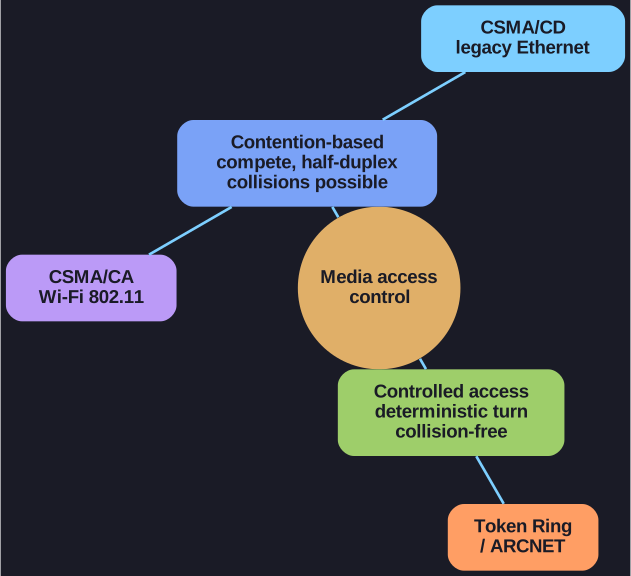
* The two families of media access control and their representative technologies. *
1. Contention-based access:
- All nodes operate in half-duplex, competing for use of the medium
- Examples:
- CSMA/CD - Used on legacy bus-topology Ethernet
- CSMA/CA - Used on Wireless LANs
2. Controlled access:
- Deterministic access where each node has its own time on the medium
- Used on legacy networks like Token Ring and ARCNET
Go deeper:
 Channel access method (Wikipedia) — taxonomy mapping both families: random/contention access (CSMA, CSMA/CD, CSMA/CA) vs controlled schemes.
- Media Access Control Methods (reachingfordreams) — splits MAC into contention-based (CSMA/CD, CSMA/CA) vs controlled access (Token Ring) with the exact framing this card uses.