Quiz Entry - updated: 2026.07.30
What did LTE introduce, and why is it called "3.9G" instead of true 4G?
LTE introduced OFDMA and an all-IP architecture, delivering 100+ Mbit/s downlink. It was labeled 3.9G because it didn't initially meet the ITU's full 4G speed requirements.
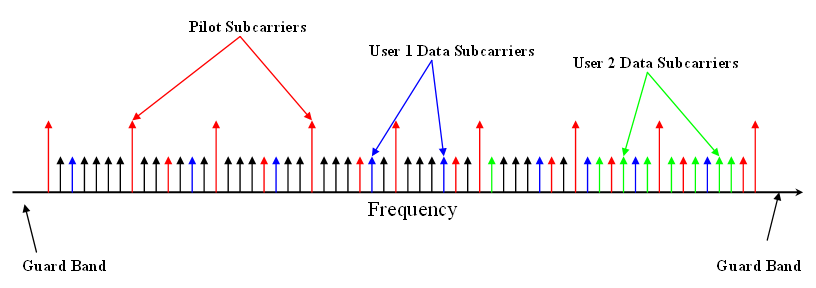
* OFDMA hands each user a slice of subcarriers. — M7ammad, Public domain, via Wikimedia Commons. *
LTE (Long Term Evolution), 2009:
- Downlink: minimum 100 Mbit/s (with 4x4 MIMO: up to 326 Mbps).
- Uplink: minimum 50 Mbit/s (up to 75 Mbit/s).
- Latency: under 10 ms round-trip. A massive improvement over 3G's 100-200 ms.
- Cell sizes: 1 km to 100 km, very flexible deployment.
- Coexistence with legacy 2G/3G standards.
Key technical innovations:
- OFDMA (Orthogonal Frequency Division Multiple Access) for downlink, SC-FDMA for uplink. These replaced W-CDMA entirely.
- MIMO (Multiple Input, Multiple Output): using multiple antennas simultaneously.
- EPC (Evolved Packet Core): a purely IP-based core network. Voice was now just another data stream, no more circuit-switched voice.
The 3.9G controversy: The ITU defined "true 4G" as requiring 1 Gbit/s for stationary users. LTE didn't meet this, so purists called it 3.9G. Only LTE-Advanced (up 500 Mbit/s, down 1 Gbit/s) technically qualifies as IMT-Advanced (true 4G). Marketing won, though, and everyone calls LTE "4G."
Go deeper:
 LTE (telecommunication) (Wikipedia) — the 4G standard, its OFDMA/SC-FDMA design and all-IP EPC core.
 Orthogonal frequency-division multiple access (Wikipedia) — how OFDMA hands each user a slice of subcarriers, with diagrams.