What do "mobile-assisted" and "network-based" mean for UMTS handover?
Mobile-assisted: the mobile station continuously measures pilot signals and reports them to the RNC. Network-based: the RNC makes the actual handover decisions.
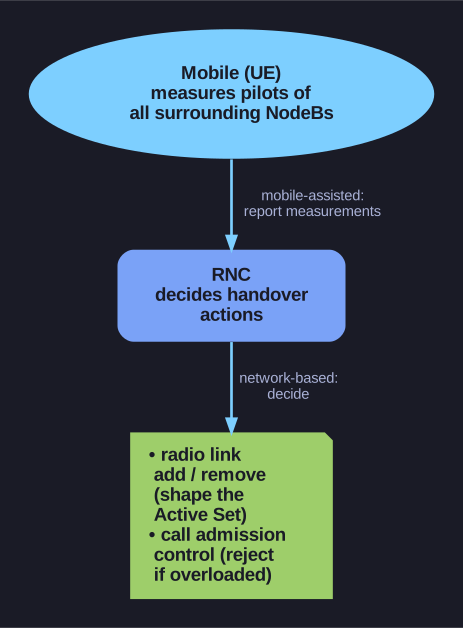
* Mobile-assisted, network-based: the phone measures and reports, the RNC decides. *
The division of labor:
| Role | Who | What |
|---|---|---|
| Mobile-assisted HO | The mobile station (MS) | Continuously measures pilot signals of surrounding NodeBs and reports to the RNC |
| Network-based HO | The RNC | Decides the handover actions |
What the RNC decides:
- Radio link addition and radio link removal — shaping the Active Set, with separate channels from each NodeB in the Active Set to the mobile
- Call admission control — e.g., rejecting a link addition when the target cell is overloaded
Why split it this way? Only the phone knows what it actually receives at its location (measurements must come from the mobile), but only the network knows the load situation across cells (decisions must consider the whole system). So: the phone senses, the network decides.
Connection to LTE: the same philosophy continues in 4G/5G — measurements from the UE, decisions in the network — even though the deciding element changed (RNC → eNodeB).
Go deeper:
 Handover (Wikipedia) — the soft (make-before-break) handover UMTS uses, and why the phone measures pilots while the RNC decides.