What do the RACH control parameters in System Information Block 1 control?
They define the rules for the random access channel: how often a channel request may be retransmitted, the minimum spacing between retries, whether re-establishment in the same cell is allowed, and which of 16 access classes may currently use the cell.
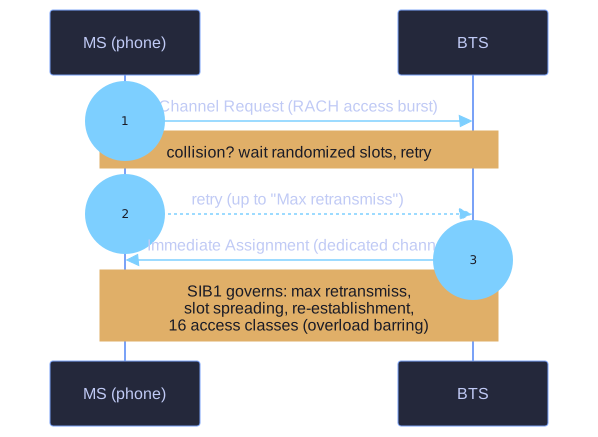
* The RACH access-and-retry that SIB1 tunes. *
The random access principle: The RACH works much like Wi-Fi's random access — just transmit and see whether it got through. On a collision (someone else transmitted simultaneously), retry after a randomized delay according to a fixed algorithm.
The parameters broadcast in SIB 1:
| Parameter | Meaning |
|---|---|
| Max of retransmiss | If the BTS doesn't answer the first channel request (e.g., collision), the phone may repeat it this many times |
| Slots to spread TX | Repeated access bursts must leave at least this many bursts of gap between them — prevents immediate re-collision |
| Cell re-establishment in cell | If the connection drops (e.g., sudden obstacle), this bit says whether re-establishing within the same cell is allowed |
| Access control class | Users are divided into 16 classes; under traffic overload, specific classes can be barred from the cell |
Why access classes matter: They are the network's overload valve — in an emergency or mass event, the cell can block ordinary subscriber classes while keeping priority classes (emergency services) working. Your SIM's access class is assigned by the operator.
Go deeper:
 Random-access channel (Wikipedia) — the shared-channel collision-and-retry principle these SIB1 parameters tune.
- GSM logical & physical channels (Electronics Notes) — where RACH sits among the common control channels (PCH/AGCH).