Quiz Entry - updated: 2026.07.30
What do the route codes C and L mean in the routing table output?
C = a directly Connected network (the network prefix on an interface); L = the Local /32 (IPv4) or /128 (IPv6) address of the router's own interface. Both appear automatically when an interface is up.
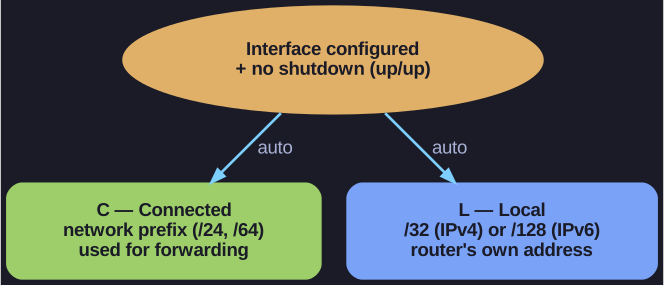
* One up interface, two automatic routes: C is the network prefix used for forwarding, L is the router's own /32 or /128 address. *
show ip route and show ipv6 route Output:
Route codes for directly connected networks:
| Code | Meaning | Description |
|---|---|---|
| C | Connected | The network directly attached to the interface |
| L | Local | The specific IP address assigned to the interface |
Example IPv4 routing table:
R1# show ip route
C    192.168.10.0/24 is directly connected, GigabitEthernet0/0/0
L    192.168.10.1/32 is directly connected, GigabitEthernet0/0/0
C    209.165.200.224/30 is directly connected, GigabitEthernet0/0/1
L    209.165.200.225/32 is directly connected, GigabitEthernet0/0/1
Key insight:
- C routes have the network prefix (e.g., /24) - used for forwarding
- L routes have /32 (IPv4) or /128 (IPv6) - identify the router's own addresses
- Routers automatically create both C and L routes when an interface is configured and up
Go deeper:
 Jeremy's IT Lab — Routing Fundamentals (CCNA Day 11) — how the routing table is built and read, including connected routes.
 Routing table (Wikipedia) — directly-connected networks and how route entries are structured and selected.