What does a cryptocurrency wallet actually run under the hood, and what do you trade away by relying on a light node?
A wallet is the program users transact through, and it normally runs a light node that downloads only block headers to validate new transactions — easy to run, but it skips several security steps a full node performs, leaving the user more exposed.
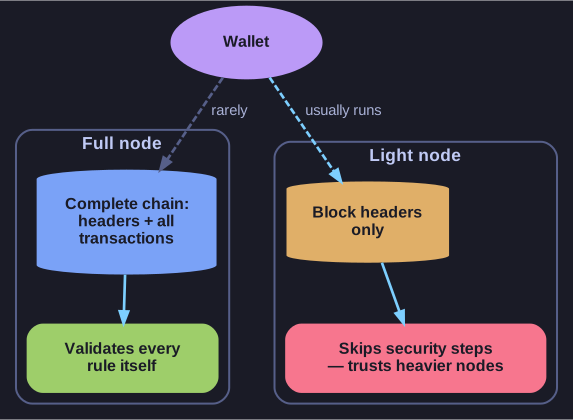
* What each node type stores decides what it can verify: the full chain lets a node check every rule; headers alone force the light node to trust the network. *
On a public chain, users typically interact through a wallet — software that supports money transfer and basic smart-contract interaction (e.g. on Ethereum). Underneath, a full node downloads, stores and validates the complete blockchain, checking every rule for itself; a light node fetches only the block headers — the chained hashes that commit to each block's contents — and uses them to check the authenticity of new transactions. That makes light nodes cheap to maintain and feasible on everyday devices, but the shortcut has a price: skipping full validation means the light client can't verify every rule independently and has to trust what the network's heavier nodes present, so it is more vulnerable than a full node.
The trust question continues up the stack: if the user goes one step further and uses a hosted wallet service, the service provider becomes a third party they must trust — a small irony on a platform whose core promise is removing trusted third parties.
Go deeper:
 Nodes and clients (ethereum.org) — full, light, and archive nodes compared: what each stores, what each can verify, and why running your own full node is the trust-minimal option.