What does Kant's motto "Sapere aude" mean, and why is it the slogan of critical thinking?
"Dare to know" — have the courage to use your own reason instead of letting others think for you.
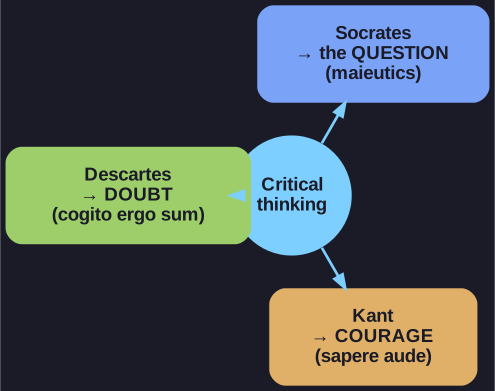
* The discipline's three classical tools — Socrates' question, Descartes' doubt, and Kant's courage to use your own reason. *
Sapere aude is Latin for "dare to be wise" / "dare to know," and Kant made it the watchword of the Enlightenment. Its target is intellectual cowardice and laziness: the temptation to outsource your judgement to authorities — a book, a priest, a doctor, a leader — so you never have to think for yourself. Kant's point is that the obstacle is not lack of intelligence but lack of courage and resolve to use the intelligence you have.
That is why it captures critical thinking: the discipline is ultimately an act of intellectual autonomy and nerve — daring to examine, to doubt, and to reach your own conclusion rather than borrowing someone else's. Kant pairs this with a second move: testing the limits and possibilities of our knowledge — knowing not just to think for yourself, but how far our reason can actually reach.
Tip: The three philosophers map to three tools — Socrates → the question, Descartes → doubt, Kant → the courage to use your own reason.
Go deeper:
 Wikipedia — Sapere aude — the phrase's history and Kant's use of it as the motto of the Enlightenment.