What does pinging a remote host test?
It tests end-to-end connectivity across an internetwork — that local TCP/IP, the gateway, routing between networks, and the remote host are all working. But a missing reply may be security filtering, not a real failure.
Ping a Remote Host:
Tests end-to-end connectivity across an internetwork.
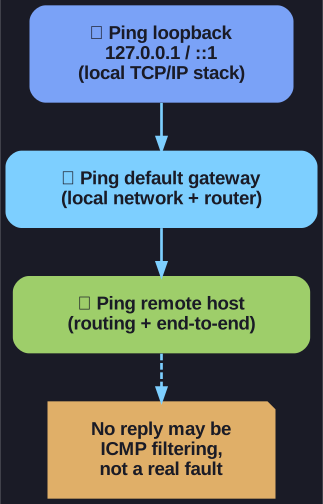
* Work outward — loopback, then gateway, then remote host — so a failure pinpoints which layer broke; remember a missing reply may be ICMP filtering, not a fault. *
Purpose:
- Verifies the local host can communicate across the network
- Tests routing between networks
- Confirms remote host is reachable
Command:
ping 10.0.0.253 (remote host IP)
What a successful ping confirms:
- Local host TCP/IP is working
- Default gateway is reachable
- Routing between networks is functional
- Remote host is operational and responding
Important Note:
Many network administrators limit or prohibit ICMP messages for security reasons. A lack of ping response could be due to security restrictions, not an actual connectivity problem.
Troubleshooting approach:
- Ping loopback (127.0.0.1)
- Ping default gateway
- Ping remote host
- If step 3 fails but others succeed, issue may be in the path or at destination
Go deeper:
 How traceroute works — when a remote ping fails, traceroute shows exactly where in the path it breaks.
 Traceroute — Wikipedia — the natural next tool after ping for diagnosing end-to-end path problems.