What does t-closeness require, and how is the "distance" between distributions measured?
t-closeness requires each equivalence class's sensitive-value distribution to stay within distance t of the whole dataset's distribution — typically measured with Earth Mover's Distance (EMD).
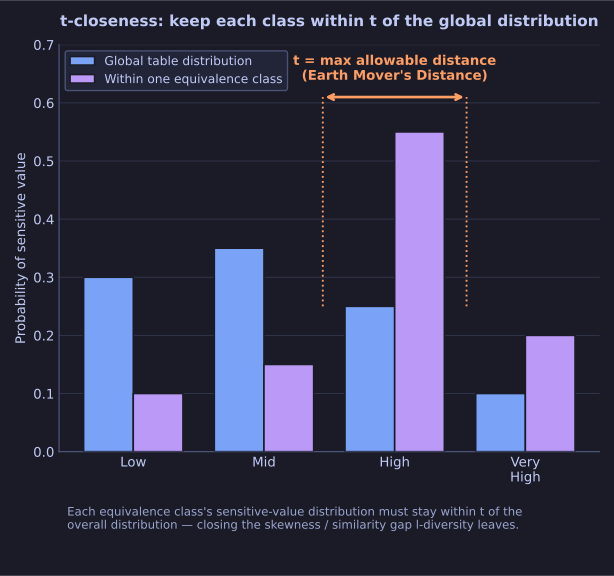
* t-closeness requires each class's sensitive-value distribution to stay within distance t (Earth Mover's Distance) of the global distribution. *
t-closeness is the third layer. Even an l-diverse group can leak information if its sensitive values are distributed very differently from the population (e.g. a rare disease over-represented). t-closeness demands that the distribution of the sensitive attribute within any equivalence class closely mirrors its distribution in the entire original database. The threshold t is the maximum allowable gap between the two distributions.
That gap is quantified with a statistical distance — commonly the Earth Mover's Distance (EMD), which intuitively measures the minimum "work" to reshape one distribution into the other. Example: with t = 0.1 on Income (sensitive) for each Age+Sex group (QIDs), every group's income distribution must be within 10% of the overall income distribution.
Tip: If every group looks statistically like the whole population, learning someone's group tells the attacker nothing new — that's the point of t-closeness.