Quiz Entry - updated: 2026.07.30
What fields make up the IPv6 base header, and how big is it?
The IPv6 base header is a fixed 40 bytes (320 bits) with just 8 fields: Version, Traffic Class, Flow Label, Payload Length, Next Header, Hop Limit, Source Address, and Destination Address.
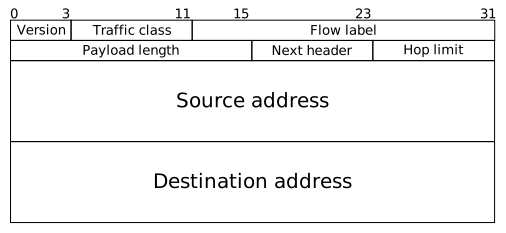
* The fixed 40-byte IPv6 base header and its eight fields. — Michel Bakni, CC BY-SA 4.0, via Wikimedia Commons. *
| Field | Size | Purpose |
|---|---|---|
| Version | 4 bits | Always 6 |
| Traffic Class | 8 bits | QoS / priority (like IPv4 DSCP) |
| Flow Label | 20 bits | Marks packets of one flow for special handling |
| Payload Length | 16 bits | Length of data after the base header |
| Next Header | 8 bits | Type of the next header (extension or upper-layer protocol) |
| Hop Limit | 8 bits | Decremented per hop; replaces IPv4 TTL |
| Source Address | 128 bits | Sender |
| Destination Address | 128 bits | Receiver |
4 + 8 + 20 + 16 + 8 + 8 + 128 + 128 = 320 bits = 40 bytes (the two 128-bit addresses alone are 256 of those bits).
Tip: The header has a fixed length — a deliberate simplification over IPv4's variable header — so even simple hardware can parse it in one fast, predictable pass.
Go deeper:
 IPv6 packet (Wikipedia) — annotated header diagram with each field's bit offset and meaning.
- RFC 8200 §3 — IPv6 Header Format — the authoritative field-by-field definition (obsoletes RFC 2460).