What four properties should a (hand-written or digital) signature provide?
Integrity, Authenticity, Non-repudiation, and "Willenserklärung" (consent / intentionality).
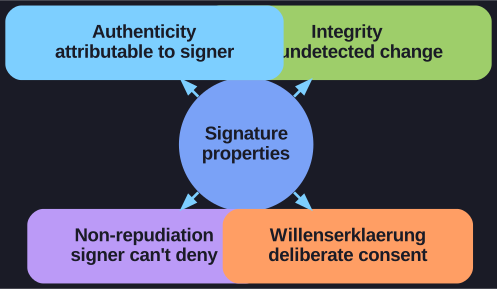
* The four properties a signature must provide — the first three are cryptographic; the fourth (Willenserklärung) is a UX/legal consent property. *
| Property | What it means | How digital signatures provide it |
|---|---|---|
| Integrity | The document cannot be (undetectably) changed after signing | The signature is computed over the document's hash; any change → hash mismatch → signature invalid |
| Authenticity | The signature can be unambiguously attributed to a specific person | Only the holder of the private key can produce a valid signature verifiable with their public key |
| Non-repudiation | The signer cannot later deny having signed | Only the private key holder could have made the signature → courts can use it as proof |
| Willenserklärung (consent / declaration of intent) | The signature can only have been placed deliberately | Provided by UX — the signing software must require explicit user action (PIN, biometric, "Sign" button) |
The first three are purely cryptographic. The fourth is a UX/legal property — a signature has to mean "I, the human, intended to sign this", not "my software automatically signed it without my knowledge."
Legal weight (qualified electronic signatures, EU eIDAS, Swiss ZertES):
- Need to be made with a secure signature creation device (SmartCard, HSM, or qualified mobile app).
- Use a certificate from a qualified trust service provider (eID services like Swiss SuisseID, Mobile-ID, etc.).
- Then they have the same legal force as a handwritten signature under Swiss / EU law.
Tip: A "self-signed PDF with a checkbox" provides integrity and (maybe) authenticity but not non-repudiation or proper Willenserklärung — it's not a qualified signature. For contracts where legal force matters, use a recognised QES provider.
Go deeper:
 Digital signature (Wikipedia) — how the crypto delivers integrity, authenticity and non-repudiation.
- Non-repudiation (Wikipedia) — the property that the signer cannot later deny having signed.