Quiz Entry - updated: 2026.07.30
What happens during the encapsulation process?
Encapsulation is a top-down process where each layer adds its own header (and the data link layer also a trailer) to the data from the layer above, until it leaves as a bit stream.
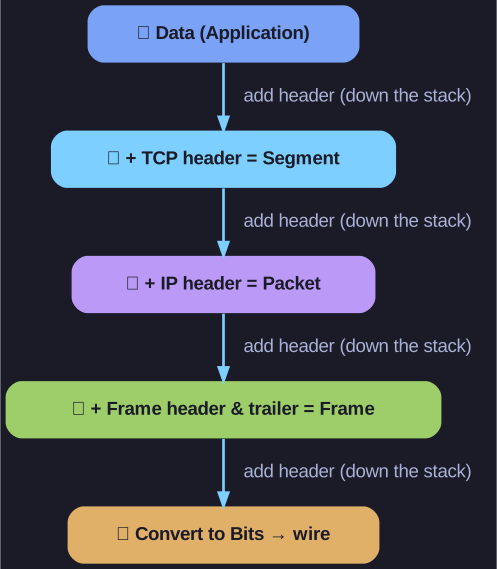
* Each layer adds its header (and L2 a trailer) going down the stack. *
Each layer wraps the data from the layer above with its own control information so the receiving device knows how to process each layer.
Process (sending):
- Application creates Data
- Transport layer adds header → Segment (Transport header + Data)
- Network layer adds header → Packet (Network header + Segment)
- Data Link layer adds header AND trailer → Frame (Frame header + Packet + Frame trailer)
- Physical layer converts to Bits for transmission
Application: DATA
Transport:   [TCP Header] + DATA = SEGMENT
Network:     [IP Header] + SEGMENT = PACKET
Data Link:   [Frame Header] + PACKET + [Frame Trailer] = FRAME
Physical:    BITS
Each layer processes and passes data down to the next level until it is sent as a bit stream.
Analogy: Encapsulation is like putting a letter in an envelope, then in a box, then wrapping the box — each layer adds another wrapper.
Go deeper:
 Encapsulation (networking) — the formal definition of headers/trailers added per layer.
- The OSI Model — Practical Networking — animated view of data being encapsulated down the stack.