Quiz Entry - updated: 2026.07.30
What happens to broadcast traffic with and without VLANs in a multi-switch network?
Without VLANs (Virtual Local Area Networks), a broadcast from any device floods to ALL devices on ALL switches. With VLANs, broadcasts are confined to only devices in the same VLAN.
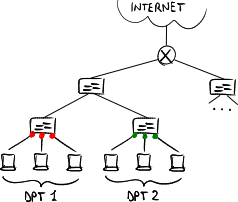
VLAN segmentation confines broadcasts per VLAN. — Luca Ghio, CC BY-SA 4.0, via Wikimedia Commons.
Without VLANs:
- A Faculty PC sends a broadcast
- All switches forward it out every port
- Every device — Faculty, Student, and Guest — receives it, even on remote switches
- All devices share one big broadcast domain (all on the same 172.17.40.0/24 subnet)
With VLANs:
- A Faculty PC in VLAN 10 sends a broadcast
- Switches only forward it out ports in VLAN 10 and over trunks
- Only the other Faculty PC (also VLAN 10) receives the broadcast
- Every device in a different VLAN (Student, Guest) is unaffected
- Each VLAN has its own subnet (VLAN 10 = 172.17.10.0/24, VLAN 20 = 172.17.20.0/24)
Critical concept: Without a Layer 3 device (router), devices in different VLANs cannot communicate at all — even if they're on the same physical switch. VLANs create complete Layer 2 isolation.
Go deeper:
 Virtual LAN (Wikipedia) — a VLAN is a separate broadcast domain, so broadcasts stay within the VLAN across trunked switches.