Quiz Entry - updated: 2026.07.30
What happens when a switch receives a frame with a destination MAC (Media Access Control) address that is NOT in its MAC address table?
The switch floods the frame out all ports except the ingress port — this is called unknown unicast flooding.
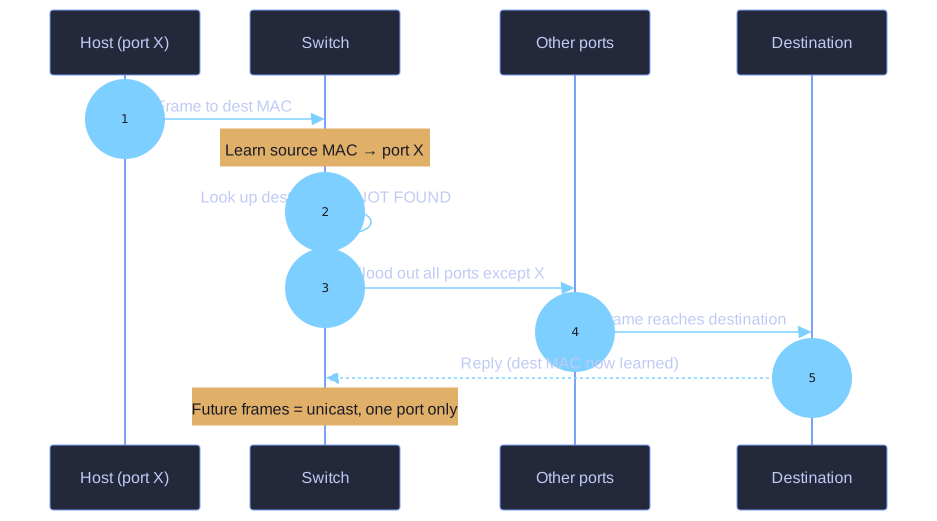
* Unknown-unicast flooding and learning. *
The full sequence when the destination is unknown:
- Frame arrives on port X
- Switch learns the source MAC → records it mapped to port X
- Switch looks up the destination MAC → not found in the table
- Switch floods the frame out all ports except port X
- The destination device receives the frame and replies
- When the reply arrives, the switch learns the destination's MAC address too
- Future frames to that destination are forwarded to the specific port only (no more flooding)
This is exactly the same behavior as for broadcast frames, but for a different reason:
- Broadcast → flooding is intentional (all devices need to see it)
- Unknown unicast → flooding is a fallback because the switch doesn't know the destination yet
Why this matters for security: An attacker can exploit this with a MAC flooding attack (CAM (Content Addressable Memory) table overflow), forcing the switch into a hub-like state where all traffic is flooded to all ports. This is why port security is important (covered in later modules).
Go deeper:
 MAC flooding (Wikipedia) — how attackers weaponize unknown-unicast flooding by overflowing the CAM table.
- Forwarding information base (Wikipedia) — the MAC-to-port table whose miss triggers the flood.