Quiz Entry - updated: 2026.07.30
What hardware features enable OS isolation and protection?
Three hardware features: CPU privilege modes (rings), MMU address translation, and the periodic timer interrupt.
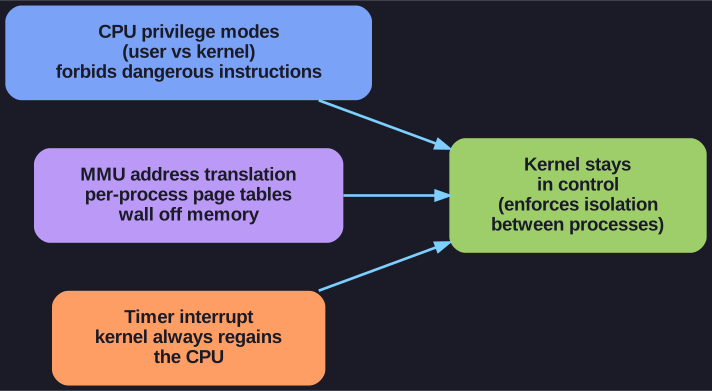
* Three hardware features keep the kernel in control: privilege modes forbid dangerous instructions, the MMU walls off memory, and the timer interrupt always returns the CPU. *
Together these keep the kernel in control: user mode forbids dangerous instructions, per-process page tables wall off memory, and the timer guarantees the kernel regains the CPU even from a program stuck in an infinite loop.
1. CPU Modes (Protection Rings on x86):
- Ring 0 (Kernel mode): All instructions allowed
- Ring 3 (User mode): Only "safe" instructions
Examples:
| Instruction | Ring 3 | Ring 0 | Purpose |
|---|---|---|---|
movq $0, %rax |
Yes | Yes | Set register |
hlt |
No | Yes | Halt processor |
wbinvd |
No | Yes | Flush caches |
2. Memory System:
- MMU performs address translation
- Each process has its own page table
- Invalid access -> page fault -> OS handles
3. Timer Interrupt:
- Hardware timer fires periodically
- Forces return to kernel
- Enables preemptive multitasking
Modern additions: Virtualization support (VT-x, nested paging).
Go deeper:
 Protection ring (Wikipedia) — the CPU mode bit that gates privileged instructions.
- Memory management unit (Wikipedia) — hardware address translation that isolates address spaces.
- System call (Wikipedia) — the trap mechanism that lets user code cross the boundary only through the kernel.