What is 5G New Radio (NR), and what techniques does it use to deliver its improvements?
5G NR is the new air interface (radio access network) of 5G, designed to support fibre-like broadband (eMBB), large-scale M2M (mMTC), and ultra-low-latency links (URLLC). It uses a wide spectrum (kHz to mmWave), new OFDMA modulation/coding, aggressive frequency reuse, Massive MIMO, and a lean base-station design.
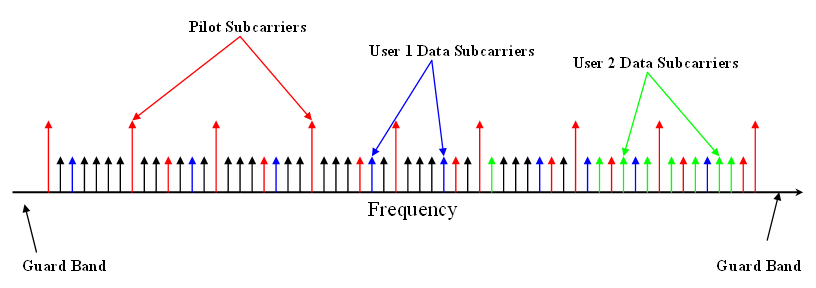
* OFDMA assigns orthogonal subcarriers to users. — Kanso & Maalouf, Public domain, via Wikimedia Commons. *
What NR is: a set of standards extending wireless communication — 5G essentially comprises the radio access network (the air interface, called 5G New Radio) plus a new core network architecture. NR's key aim is to grow wireless communication by efficiently using a larger frequency spectrum for mobile broadband.
The improvements NR brings:
- Wide spectrum: from a few hundred kHz up to mmWave — enabling diverse use cases, cell sizes, and data rates
- New modulation: OFDMA (Orthogonal Frequency-Division Multiple Access) and new channel-coding techniques
- Frequency-reuse algorithms that work even in high-density environments
- Massive MIMO (many antennas)
- Low latency via lean design: a "functional split" in the base station designed for ultra-low-latency communication
The three design targets map to the use cases: NR was built (1) for fibre-bandwidth transmissions → eMBB, (2) for low-bandwidth large-scale M2M → mMTC, and (3) for extremely low-latency transmissions (vehicle-to-vehicle/infrastructure) → URLLC.
Tip: NR = the radio half of 5G. The other half is the cloud-native 5G core. Together they replace LTE's E-UTRAN + EPC.
Go deeper:
 5G signals: OFDM waveforms, Frame Structure, and Numerology (MATLAB) — animated walk-through of how NR builds the OFDM waveform and why it offers multiple numerologies (subcarrier spacings) — the clearest single video on NR's waveform.
 Numerology / SCS (Subcarrier Spacing) in detail (ShareTechnote) — NR's flexible numerology (15/30/60/120/240 kHz via 2^µ·15 kHz), how symbol duration and cyclic prefix scale, and why mmWave needs wider spacing — far deeper than the generic OFDM articles.
- Orthogonal frequency-division multiplexing (Wikipedia) — the multi-carrier modulation OFDMA is built on; how closely-spaced orthogonal sub-carriers pack data without inter-carrier interference (and the carousel's diagram source).