Quiz Entry - updated: 2026.07.30
What is a broadcast domain, and what type of device can break it up?
A broadcast domain is the set of all devices that receive a broadcast frame. Only a Layer 3 device (router) can break up a broadcast domain.
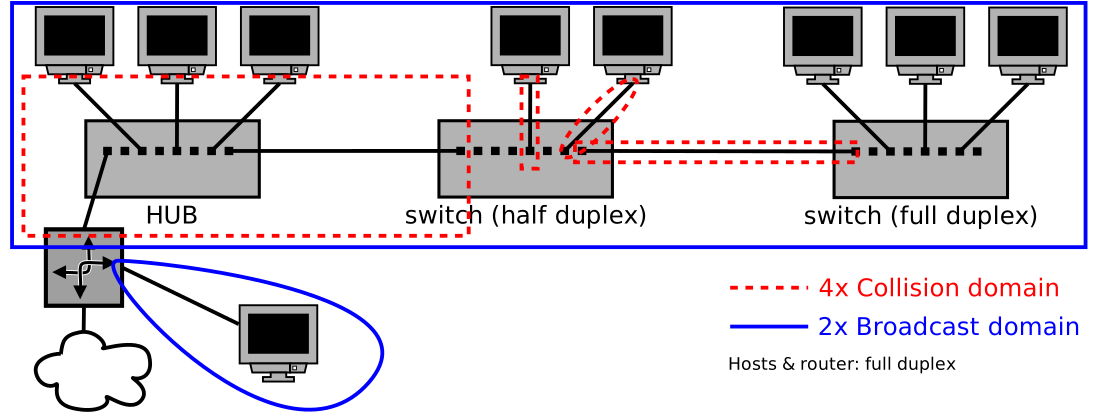
* Broadcast domains are bounded by a router. — Mattias.Campe, CC BY-SA 4.0, via Wikimedia Commons. *
Key facts about broadcast domains:
- A broadcast domain spans all Layer 1 and Layer 2 devices interconnected on a LAN (Local Area Network)
- When a switch receives a broadcast frame (destination
FF:FF:FF:FF:FF:FF), it floods it out all interfaces except the ingress port - Adding more switches or hubs expands the broadcast domain — more devices receive every broadcast
Why this matters:
- Too many broadcasts = congestion and poor performance (called a broadcast storm in extreme cases)
- Every device in the domain must process every broadcast, consuming CPU (Central Processing Unit) and bandwidth
- Common broadcast traffic includes: ARP (Address Resolution Protocol) requests, DHCP discovery, NetBIOS
How to limit broadcast domains:
- Routers — each router interface is a separate broadcast domain
- VLANs (Virtual Local Area Networks) — a Layer 2 method to logically segment broadcast domains on a single switch (covered in later modules)
- Layer 3 switches — switches with routing capability
Tip: Switches break up collision domains (good), but extend broadcast domains (potentially bad). Routers break up both.
Go deeper:
 Broadcast domain (Wikipedia) — defines the domain and shows routers (and VLANs) as the boundary that breaks it up.