What is a collision attack, and how does it differ from a pre-image attack?
A collision attack finds ANY two different messages with the same hash (attacker controls both), while a pre-image attack must match a specific given hash.
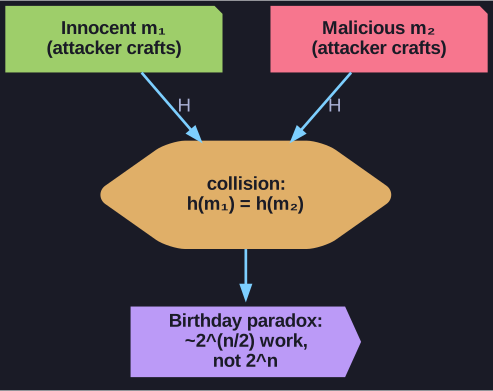
* The attacker crafts both messages; the birthday paradox cuts the work to $\sim 2^{n/2}$. *
Collision attack: Find $m_1 \neq m_2$ such that:
$$h(m_1) = h(m_2)$$
The attacker is free to choose both messages.
Pre-image attack: Given a specific $h(m)$, find $m' \neq m$ such that $h(m') = h(m)$.
Why collisions are easier to find:
- Pre-image: ~$2^n$ attempts needed (brute force)
- Collision: ~$2^{n/2}$ attempts needed (birthday paradox!)
For SHA-256: pre-image needs $2^{256}$, but collision only needs $2^{128}$ attempts.
Collision attack scenario: Eve creates two documents — an innocent one ($m_1$) and a malicious one ($m_2$) — with the same hash. She gets Alice to sign the innocent one. The signature is equally valid for the malicious document.
Tip: The birthday paradox makes collisions much easier: in a room of just 23 people, there's a >50% chance two share a birthday. Similarly, hash collisions appear much sooner than you'd intuitively expect.
Go deeper:
 Collision attack — classical and chosen-prefix collisions.
- Birthday attack — why collisions need only 2^(n/2) work.