What is a default route, and how does the longest-prefix-match rule make it the "gateway of last resort"?
A default route — 0.0.0.0/0 for IPv4 or ::/0 for IPv6 — matches every destination, but with a prefix length of /0 it requires zero matching bits. So under longest-prefix match it is the least specific route possible and is only chosen when no more-specific route matches: the gateway of last resort.
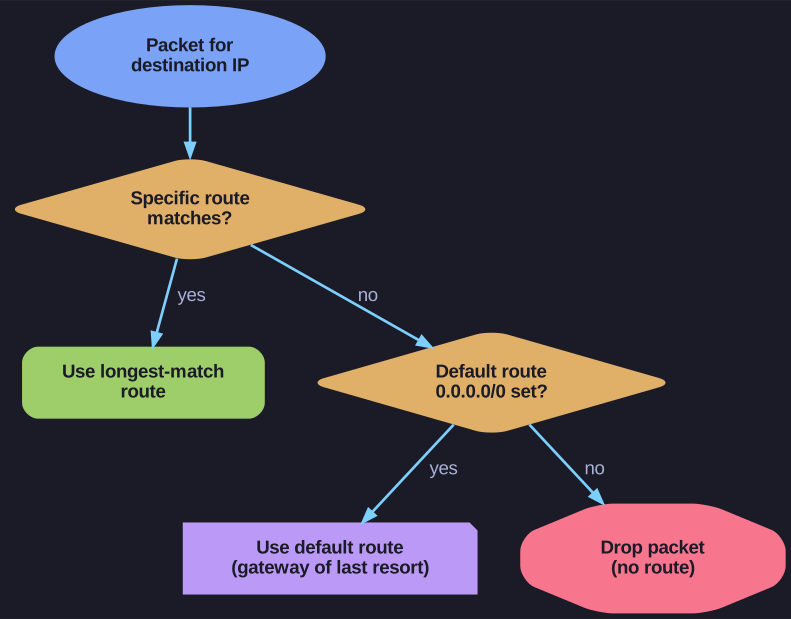
* How a default route fits the longest-match lookup. *
Why /0 means "match anything, but lose to everything":
- The prefix length says how many far-left bits must match. A /0 prefix demands 0 bits — so every destination IP matches it.
- But longest-prefix match always prefers the route with the most matching bits. Any real route (a /8, /24, /28…) is longer than /0, so it always wins over the default.
- The result: the default route catches only the traffic that nothing else does — exactly the "send everything I don't recognise this way" behaviour you want at a network edge.
Where it comes from:
- It can be manually configured as a static route (e.g.
ip route 0.0.0.0 0.0.0.0 <next-hop>), or - learned dynamically from a routing protocol that advertises a default.
How it shows in the table: a candidate default route is flagged with * (e.g. S*), and the router reports Gateway of Last Resort is <next-hop>. If no default is set, the output reads Gateway of Last Resort is not set and unmatched packets are dropped.
Tip: A default route is the routing equivalent of "if you don't know where it goes, send it to the post office." It's the single most common static route — edge routers point 0.0.0.0/0 at the ISP so they don't need a route for the entire internet.
Go deeper:
 Default route (Wikipedia) — the 0.0.0.0/0 / ::/0 forwarding rule used when no specific route matches.