Quiz Entry - updated: 2026.07.30
What is a generalization hierarchy, and what happens to privacy and utility as you climb it?
A generalization hierarchy defines progressively broader versions of a value; moving up increases privacy but destroys utility.
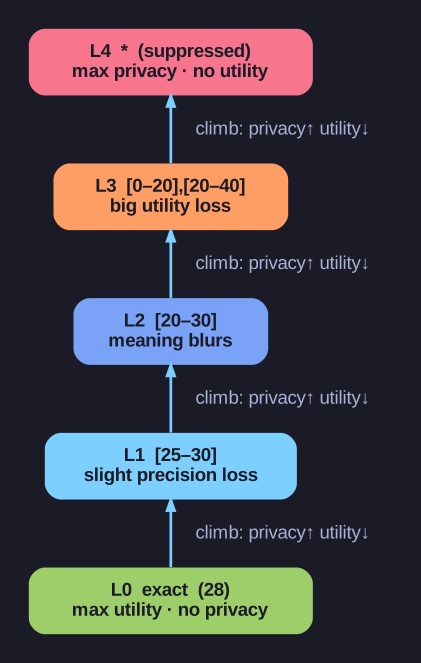
* A generalization ladder: climbing trades utility for privacy; algorithms climb only as high as needed. *
Each quasi-identifier gets a ladder of abstraction, e.g. for Age:
- L0 — Exact values (28): maximum utility, zero anonymization.
- L1 — Small ranges ([25–30]): slight precision loss.
- L2 — Wider ranges ([20–30]): meaning starts to blur.
- L3 — Very broad ([0–20], [20–40]): significant utility loss.
- L4 — Full suppression (
*): maximum privacy, zero utility from that attribute.
The anonymization algorithm searches for the minimum generalization level that still hits the target k — climbing only as high as necessary, to preserve as much utility as possible.
Tip: Privacy and utility sit on a seesaw. Good hierarchies (and good algorithms) let you buy the privacy you need with the smallest possible utility payment.
Go deeper:
 k-anonymity (Wikipedia) — generalization ladders and the privacy/utility trade.
- k-Anonymity (Sweeney, 2002) — formal treatment of generalization hierarchies.