What is a handover (handoff) in mobile networks?
A handover is the automatic transfer of an active connection from one base station to another as the mobile device moves across cell boundaries.
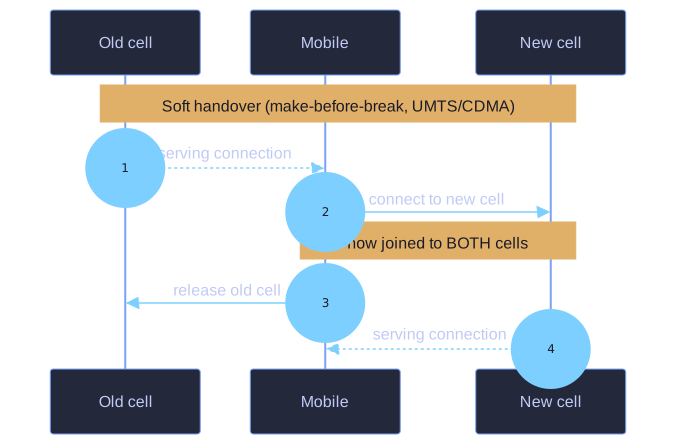
* Soft handover (make-before-break): join new cell, then drop old. *
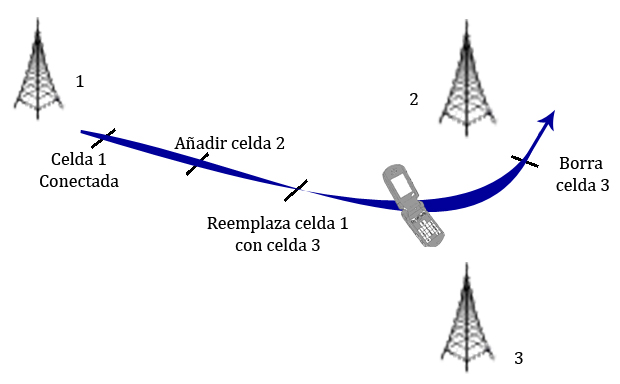
* Soft handover: join the new cell before dropping the old. — Angelalg, Public domain, via Wikimedia Commons. *
When you're on a phone call or streaming data while driving, your device continuously measures signal quality from surrounding base stations. When a neighboring cell offers a stronger signal, the network triggers a handover.
Key properties:
- Happens automatically — the user doesn't notice (ideally)
- The connection is maintained without interruption (in theory — in practice, there can be brief gaps, especially with older standards like GSM)
- The network coordinates the transfer, not the device
Types of handover:
- Hard handover — break-before-make: disconnect from old cell, then connect to new (used in GSM)
- Soft handover — make-before-break: connect to new cell first, then disconnect from old (used in UMTS/CDMA)
Handover is one of the fundamental challenges in mobile network design — getting it wrong causes dropped calls and buffering.
Go deeper:
 LTE measurement-report events that trigger handover (ShareTechnote) — the real mechanism: A3 ("neighbour offset-better than serving"), RSRP/RSRQ, L3 filtering and the hysteresis that stops ping-pong handovers.
- Handover (Wikipedia) — the general handoff process across cellular generations.
- Soft handover (Wikipedia) — the CDMA/W-CDMA make-before-break technique and why it cuts dropped calls.