What is a MAC address, how is it structured, and how is it represented?
A 48-bit (6-byte) hardware address shown as 12 hexadecimal digits; the first 24 bits are the IEEE-assigned OUI (vendor) and the last 24 bits are the vendor-assigned device value.
A MAC (Media Access Control) address is the permanent hardware identity of a network interface card (NIC) — it is burned into the NIC and is what Ethernet uses to deliver a frame to a specific device on a LAN. Because one byte (8 bits) equals two hex digits, a 48-bit address is written as 12 hexadecimal digits, grouped with colons or hyphens (e.g. 00-50-56-C0-00-01).
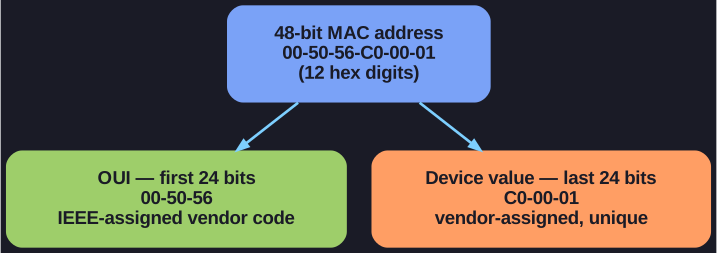
* The first 24 bits are the IEEE-assigned OUI (vendor) and the last 24 bits are the vendor-assigned device value. *
The 48 bits split into two halves, and this split is what guarantees global uniqueness:
| Part | Size | Meaning |
|---|---|---|
| OUI (Organizationally Unique Identifier) | first 24 bits (3 bytes) | a vendor code the manufacturer buys/registers from the IEEE |
| Device value | last 24 bits (3 bytes) | a serial-like number the vendor assigns, unique within its OUI |
In 00-50-56-C0-00-01 the OUI 00-50-56 belongs to VMware and C0-00-01 is that vendor's device value. Because the IEEE hands out OUIs and each vendor never reuses a device value, no two NICs worldwide should share a MAC address — which is exactly what's needed for unambiguous local delivery.
Go deeper:
-
 MAC address (Wikipedia) — the 48-bit format, OUI/device split, and unicast/multicast/broadcast bits.
 -
Organizationally unique identifier (Wikipedia) — the 24-bit vendor code organizations register from the IEEE.