Quiz Entry - updated: 2026.07.30
What is a Solicited-Node Multicast Address and why is it more efficient than broadcast?
ff02::1:ff00:0/104 plus the last 24 bits of a unicast address. Unlike a broadcast, only the few hosts sharing those 24 bits — usually just one — must process the frame.
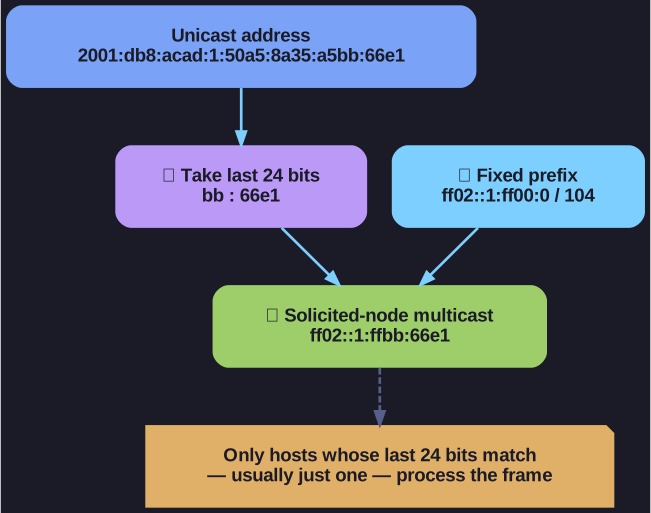
* Mapping a unicast address to its solicited-node multicast group. *
Solicited-Node Multicast Address:
A special multicast address derived from a device's unicast address.
Format:
ff02:0000:0000:0000:0000:0001:ffxx:xxxx
      └───────────────────────┘└──────┘
            Fixed prefix        Last 24 bits
                                of unicast
Example:
- GUA: 2001:db8:acad:1:50a5:8a35:a5bb:66e1
- Solicited-node: ff02::1:ffbb:66e1
Why use Solicited-Node addresses?
| Broadcast (IPv4) | Solicited-Node (IPv6) |
|---|---|
| All devices must process | Only target device processes |
| Wastes CPU cycles | More efficient |
| One address for all | Unique per unicast address |
Process:
- Frame sent with solicited-node multicast MAC
- Switch forwards to relevant ports only
- NIC filters by destination MAC
- Only intended recipient processes the packet
Key insight: Solicited-node multicast is used for Neighbor Discovery, replacing ARP broadcasts.
Go deeper:
 RFC 4291 §2.7.1 — Solicited-Node Multicast Address — the formal ff02::1:ff00:0/104 + low-24-bits construction.
- Multicast address — solicited-node (Wikipedia) — the derivation and why it scopes address-resolution to almost-always one host.