What is a VLAN and what are its key benefits?
A VLAN (Virtual Local Area Network) is a logical grouping of devices on one or more switches that creates separate broadcast domains, regardless of physical location.
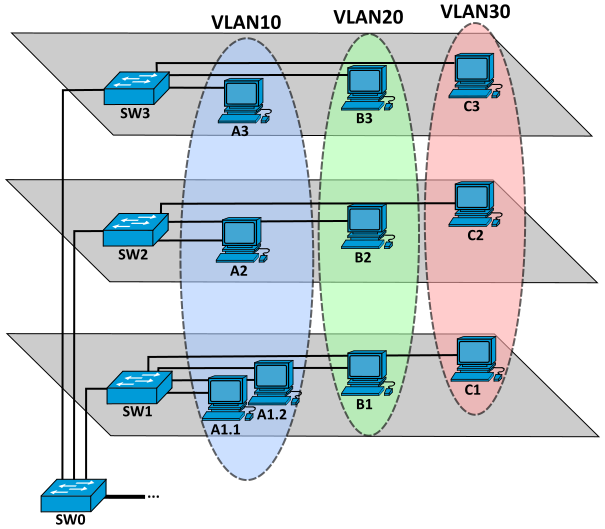
VLANs as logical broadcast domains across switches. — Michel Bakni, CC BY-SA 4.0, via Wikimedia Commons.
Without VLANs, all devices connected to a switch share the same broadcast domain — every broadcast reaches every device. VLANs solve this by creating logical segments at Layer 2.
Key benefits:
| Benefit | Why It Matters |
|---|---|
| Smaller broadcast domains | Fewer devices receive each broadcast → less wasted bandwidth |
| Improved security | Only devices in the same VLAN can communicate directly at Layer 2 |
| Improved IT efficiency | Group devices by function (e.g., faculty vs. students) rather than physical location |
| Reduced cost | One switch can serve multiple groups — no need for separate physical switches |
| Better performance | Smaller domains = less unnecessary traffic |
| Simpler management | Similar groups share the same applications and network policies |
Each VLAN gets its own IP (Internet Protocol) subnet (e.g., VLAN 10 = 10.0.2.0/24, VLAN 20 = 10.0.3.0/24). Devices in different VLANs cannot communicate without a Layer 3 device (router or Layer 3 switch).
Tip: Think of VLANs as invisible walls inside a switch — devices on the same VLAN can talk freely, but crossing VLAN boundaries requires a router.
Go deeper:
 Virtual LAN (Wikipedia) — defines VLANs as logical broadcast domains and lays out the segmentation/security/management benefits, with topology diagrams.