What is a zero-knowledge proof (ZKP)?
A method by which one party (the prover) convinces another (the verifier) that a statement is true — without revealing anything beyond the fact that it is true.
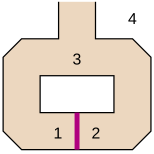
* The classic "cave" illustration of a zero-knowledge protocol. — RokerHRO, Public domain, via Wikimedia Commons. *
The magic is in what is not shared. A ZKP lets you prove you know a secret, or that a fact holds, while leaking zero additional information — not the secret itself, not how you know it.
Classic framing — two things happen at once:
- You prove a statement is true (the verifier ends up convinced).
- The verifier learns only that it's true — nothing about the secret behind it.
(The formal version of these guarantees — completeness, soundness, and zero-knowledge — is covered in the next card.)
Everyday analogies:
- Proving you're over 18 without showing your birth date.
- Proving you know a password without sending the password.
- Proving you can solve a maze without revealing the path.
Tip: Remember it as "I can prove I know it, without telling you what it is."
Go deeper:
 Zero-knowledge proof (Wikipedia) — the prover/verifier framing and worked protocol examples.