What is an Antennensuchlauf (cell-tower dump / antenna search), what does it target, and what is its purpose?
Unlike the other measures, it targets an antenna (not a SIM) for a time window of about 2 hours, and returns a list of all subscribers connected to that antenna during that period — to build a pool of suspects that can be prioritised by intersecting it with other pools.
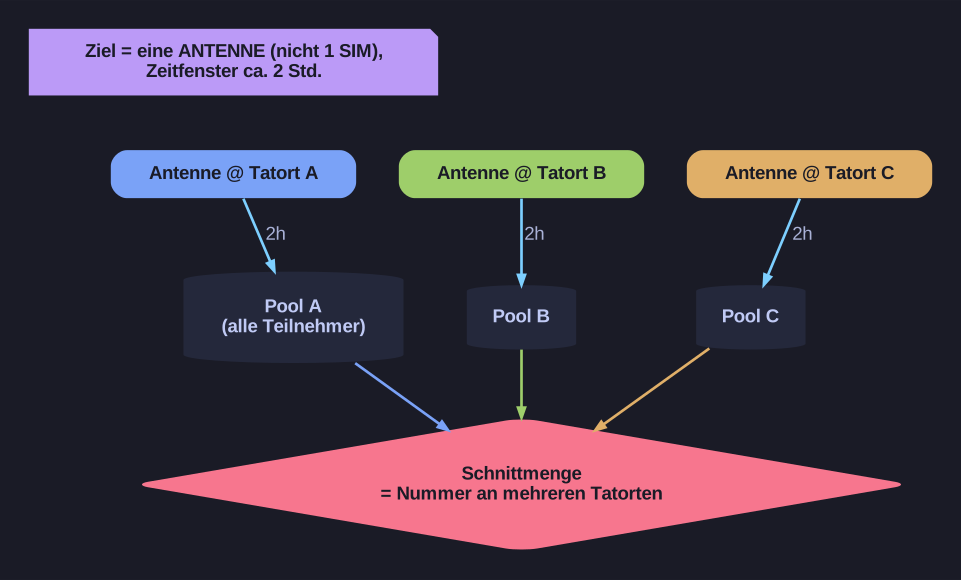
* Antennensuchlauf: die Schnittmenge der Tatort-Pools priorisiert Verdaechtige. *
The defining feature is an inversion of target. Every other measure in this topic targets one subscriber (one SIM); the Antennensuchlauf instead targets one antenna, for a window of about 2 hours. The result is a list of all subscribers that were connected to that antenna during the defined period — everyone present at that place and time.
That list is a pool of suspects, and on its own it is mostly innocent bystanders. The value comes from intersecting it with other pools: a number that shows up at several crime scenes is far more interesting than any number at one. The concrete pattern, for a series of cash-transport robberies or ATM bombings, is to run an Antennensuchlauf at each scene and ask which numbers appear at multiple scenes, then prioritise numbers belonging to already-known persons, and finally cross-reference against other information such as people matching a witness description (enormously labour-intensive, but sometimes decisive).
The privacy tension is built in: the measure sweeps up everyone near a location, overwhelmingly the uninvolved, which is exactly why it is sensitive and why the resulting haystack of numbers must be narrowed by cross-referencing rather than treated as a suspect list outright.
Tip: Antennensuchlauf = "who was here during this window?" — the one measure that starts from a place, not a person, producing a haystack you then narrow down.
Go deeper:
 Analysis of Mobile Phone Geolocation Methods Used in US Courts (IEEE Access, 2022) — open-access survey of how cell-association, ToA/ToF, and tower-dump data are actually used (and challenged) as location evidence in court — the forensic rigour behind "which antenna was the phone on."