What is an enthymeme, and why is the missing piece so often left out on purpose?
An enthymeme is a shortened argument with an unstated premise — and in everyday speech the missing piece is usually the contestable normative rule.
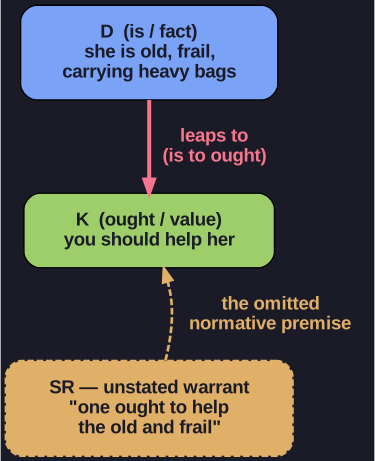
* An enthymeme hides the warrant: the jump from an "is" (the facts) to an "ought" (the conclusion) needs an unstated normative premise. *
An enthymeme is an argument where a premise (often the warrant/bridging rule) is left implicit because it "goes without saying." In Toulmin terms, the warrant (SR) is omitted.
Worked example: "You should help this woman, because she's old and frail and carrying two heavy suitcases."
- Data (D): she is old, frail, carrying two heavy suitcases.
- Conclusion (K): you should help her.
- Missing warrant (SR): "One ought to help old and frail people." Nobody states it.
The reason the warrant gets dropped is revealing: the facts (D) are descriptive, but the leap to a should (K) needs a normative premise — a value rule. Those moral premises are often deliberately left out because they're contestable and would force a deeper discussion. So the trick of reconstructing an argument is to supply the missing premise — that's exactly where a weak or sneaky argument shows itself.
Tip: When a "fact" suddenly produces an "ought," hunt for the buried value premise. The gap between is and ought is where enthymemes hide their assumptions.
Go deeper:
 Enthymeme — Wikipedia — the argument with a hidden premise, from Aristotle to modern rhetoric.