What is an "epistemic virtue," and how does it differ from a cognitive ability?
An acquired, cultivated disposition or character trait that improves your thinking, research and learning — earned, not innate.
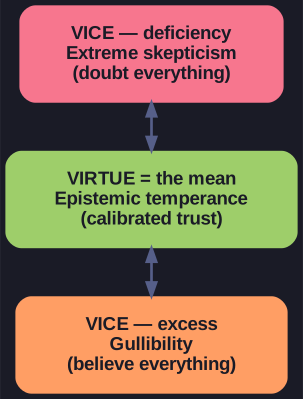
* A virtue sits between two vices — epistemic temperance is the calibrated mean between extreme skepticism and gullibility. *
Epistemic virtues are cultivated dispositions that shape good epistemic conduct. The contrast with cognitive abilities is the whole point:
- Cognitive abilities are largely innate/given (memory, perception) — equipment you have.
- Epistemic virtues are acquired and cultivated — habits of character you develop over time.
Examples include open-mindedness (taking dissenting arguments seriously), humility (acknowledging your limits), courage (facing unpopular truths), perseverance (not quitting when it's hard), conscientiousness (careful with evidence), curiosity, critical self-reflection (checking your own biases), fairness (representing opponents' arguments correctly), integrity (coherence between what you say and do about knowledge), creativity, and epistemic temperance (balancing skepticism and trust).
Tip: A virtue typically sits between two vices. Epistemic temperance is the clearest case: too little trust → extreme skepticism, too much → gullibility; the virtue is the calibrated middle.
Go deeper:
 Epistemic virtue (Wikipedia) — cultivated intellectual character traits.
- Golden mean (Wikipedia) — Aristotle's virtue-as-the-mean, the idea behind epistemic temperance.