Quiz Entry - updated: 2026.07.30
What is an HTTP GET request, and what are the key parts of a typical HTTP exchange?
A GET request asks the server "give me this resource." The exchange is plain text: request line, headers, blank line, optional body — followed by a response with status code, headers, and the actual content.
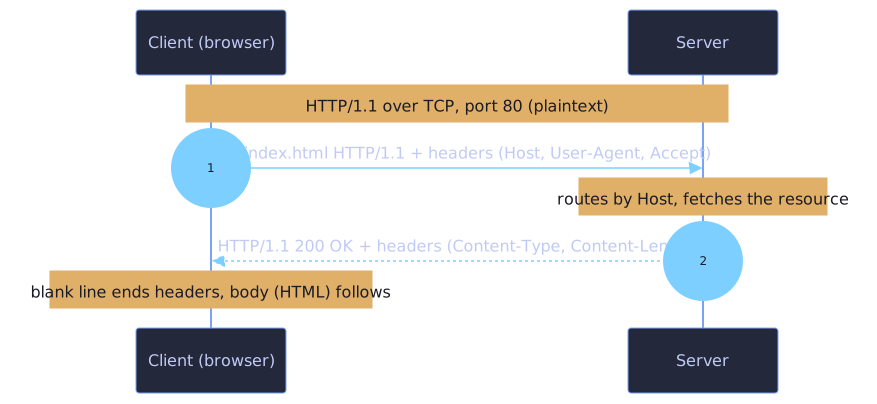
* The HTTP request/response exchange: a GET with headers, answered by a status line, headers, and body. *
Anatomy of a GET request:
GET /index.html HTTP/1.1                ← Request line
Host: www.example.com                   ← Required in HTTP/1.1+
User-Agent: Mozilla/5.0 ...
Accept: text/html,application/xhtml+xml
Accept-Language: en-US,en;q=0.9
Cookie: sessionid=abc123
Connection: keep-alive
                                        ← Blank line marks end of headers
                                        ← (GET has no body)
Anatomy of a response:
HTTP/1.1 200 OK                         ← Status line
Server: nginx/1.18.0
Content-Type: text/html; charset=utf-8
Content-Length: 4823
Date: Wed, 13 Mar 2026 14:23:01 GMT
                                        ← Blank line
<!DOCTYPE html>                         ← Body
<html>...
Key concepts:
- Methods: GET, POST, PUT, DELETE, HEAD, OPTIONS, PATCH
- GET = idempotent, safe — calling repeatedly has the same effect (no state change)
- POST = state-changing — typically used for submitting data
- Stateless — each request is independent; sessions are tracked via cookies
Status code categories:
| Range | Meaning | Examples |
|---|---|---|
| 1xx | Informational | 100 Continue |
| 2xx | Success | 200 OK, 201 Created, 204 No Content |
| 3xx | Redirect | 301 Moved Permanently, 302 Found, 304 Not Modified |
| 4xx | Client error | 400 Bad Request, 401 Unauthorized, 403 Forbidden, 404 Not Found |
| 5xx | Server error | 500 Internal Server Error, 502 Bad Gateway, 503 Service Unavailable |
Why HTTP is plaintext (and why that's a security disaster):
- Anyone on the path (WiFi, ISP, gateway) can read it
- Cookies, passwords (if not on HTTPS), and content are visible
- This is exactly why HTTPS (HTTP over TLS) replaced HTTP for almost all real traffic
Tip: neverssl.com is a deliberately HTTP-only site for testing — useful for diagnosing captive portals (which intercept HTTP traffic to show login pages).
Go deeper:
 Hypertext Transfer Protocol (Wikipedia) — request line, headers, methods and response structure in one place.
- HTTP response status codes (MDN) — the authoritative 1xx–5xx catalogue.