Quiz Entry - updated: 2026.07.30
What is an SVI, and what are the advantages of using a Layer 3 switch for inter-VLAN routing?
An SVI (Switch Virtual Interface) is a virtual interface on a Layer 3 switch configured for a specific VLAN (Virtual Local Area Network), and Layer 3 switches are faster, simpler, and more scalable than router-on-a-stick.
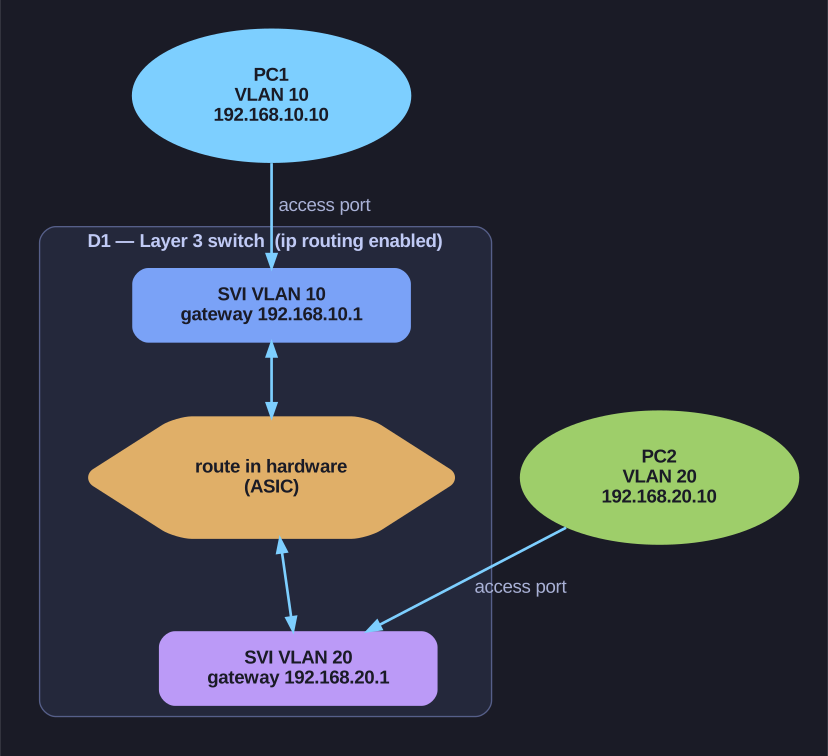
* Each SVI is a VLAN's gateway; the switch routes between them in hardware, no external link needed. *
What is an SVI?
- A virtual Layer 3 interface created on a switch for a VLAN
- Configured with
interface vlan <vlan-id>— the same command used for management VLANs on Layer 2 switches - Provides Layer 3 processing (routing) for all packets entering or leaving that VLAN
- The SVI's IP (Internet Protocol) address serves as the default gateway for hosts in that VLAN
Advantages over router-on-a-stick:
| Advantage | Why |
|---|---|
| Much faster | Hardware-switched and routed using ASICs (Application-Specific Integrated Circuits), not software routing |
| No external link needed | No cable from switch to router — routing happens inside the switch |
| Higher bandwidth | Can use EtherChannels for inter-switch trunks, not limited to one link |
| Lower latency | Traffic doesn't leave the switch to be routed |
| More common | Standard in enterprise campus LANs (Local Area Networks) |
The only disadvantage: Layer 3 switches are more expensive than Layer 2 switches.
Go deeper:
 Switch virtual interface (Wikipedia) — defines the SVI as a logical L3 interface on a multilayer switch and the hardware-switched, low-latency advantage over an external router.