What is an SVI (Switch Virtual Interface) and why does a switch need one for management?
An SVI is a virtual Layer 3 interface bound to a VLAN (Virtual Local Area Network); it gives the Layer 2 switch an IP address so it can be reached for remote management, which frame-forwarding alone never needs.
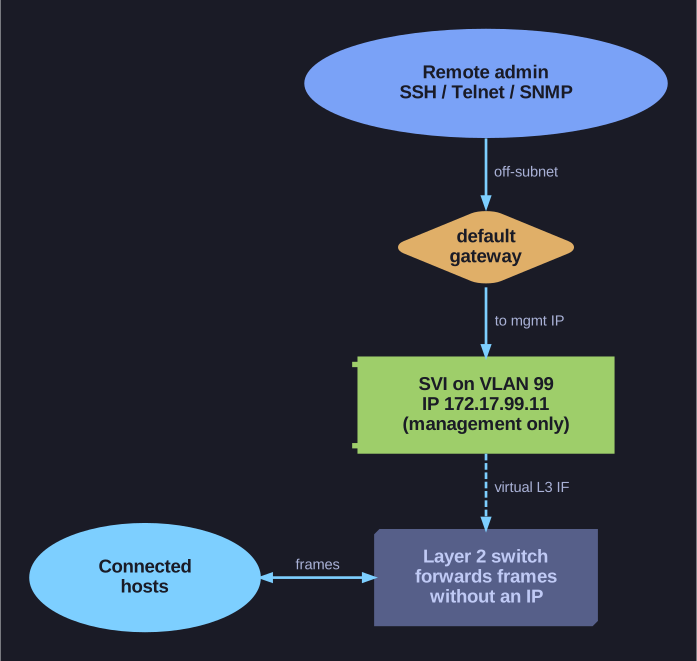
* The SVI gives the switch a management IP without making it route traffic. *
A switch is a Layer 2 device — it doesn't need an IP (Internet Protocol) address to forward frames. But to manage the switch remotely (SSH (Secure Shell), Telnet, SNMP (Simple Network Management Protocol)), it needs an IP address. The SVI provides this.
Key facts:
- By default, management is through VLAN 1 (all ports assigned to VLAN 1)
- Security best practice: Use a VLAN other than VLAN 1 for management (e.g., VLAN 99)
- The SVI needs: IP address + subnet mask
- For remote network management: also configure a default gateway
- The SVI will not show as "up/up" until the VLAN is created AND a device is connected to a port in that VLAN
Important: An IP on the SVI is only for management access — it does NOT allow the switch to route Layer 3 packets (unless it's a Layer 3 switch).
Go deeper:
 Switch virtual interface (Wikipedia) — defines the SVI as a logical L3 interface on a VLAN, also enabling inter-VLAN routing on multilayer switches.