Quiz Entry - updated: 2026.07.30
What is ARP (Address Resolution Protocol), and what fundamental problem in networking does it solve?
ARP maps IP addresses to MAC addresses within a LAN — without it, you can't actually deliver a packet to a physical machine even if you know its IP.
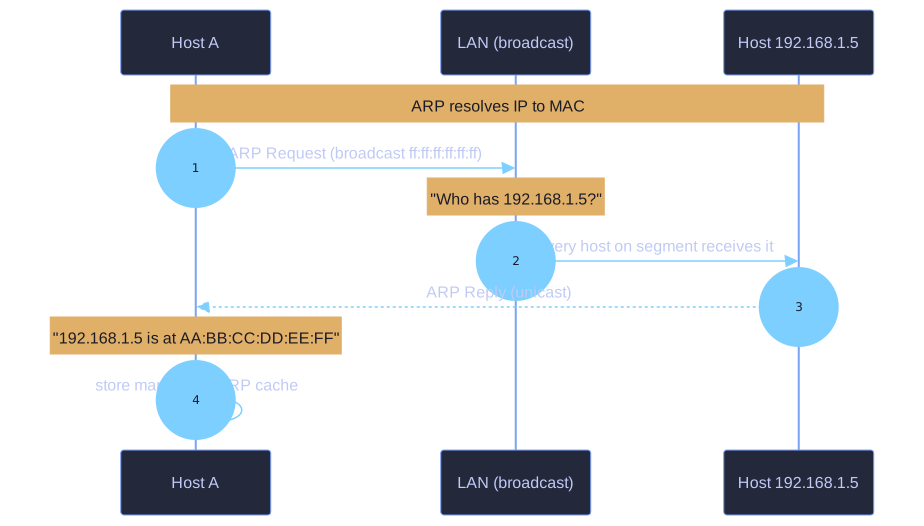
* ARP resolves IP→MAC: broadcast the question, unicast the reply, cache it. *
The core problem:
- The network you're talking on (Ethernet, WiFi) speaks MAC addresses (Layer 2)
- The applications you run speak IP addresses (Layer 3)
- When you want to send
192.168.1.5something, the NIC needs to know: which MAC address does that correspond to?
How ARP solves it:
- Host wants to send to
192.168.1.5— checks its ARP cache - Cache miss → sends an ARP Request as a broadcast: "Who has 192.168.1.5?"
- The host with that IP replies with its MAC: "192.168.1.5 is at AA:BB:CC:DD:EE:FF"
- Sender stores the mapping in its ARP cache for future use
Why it's needed only on a LAN:
- ARP only works within a single broadcast domain (LAN segment)
- For traffic going to other networks, the host ARPs for the default gateway's MAC instead — the gateway then handles the rest of the journey via routing
Inspect/clear the ARP cache:
arp -a       # view ARP table (Windows/Linux)
arp -d       # delete entries (Windows, requires admin)
ip neigh     # modern Linux equivalent
Tip: The classic "Layer 2 vs Layer 3" confusion clears up if you remember: routers operate on IP, switches operate on MAC. ARP is the bridge between them.
Go deeper:
 Address Resolution Protocol (Wikipedia) — full packet-format breakdown, ARP cache behaviour, and the spoofing attacks built on it.
- RFC 826 — An Ethernet Address Resolution Protocol — the original 1982 spec; short enough to read end-to-end and see exactly why the target-MAC field starts empty.