What is bandwidth and what are the common units of measurement?
Bandwidth is a medium's capacity to carry data — how many bits can move per second — measured in bps and scaled up as Kbps, Mbps, Gbps, and Tbps.
Bandwidth is the capacity at which a medium can carry data - how many bits can flow from one place to another in a given amount of time. Available bandwidth is determined by the physical properties of the media, current technology, and the laws of physics.
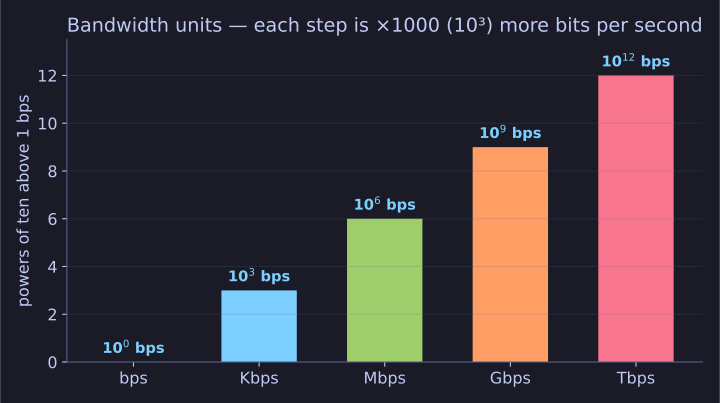
* Each unit is a factor of 1000 (10³) larger than the previous: bps → Kbps → Mbps → Gbps → Tbps. *
| Unit | Abbreviation | Equivalence |
|---|---|---|
| Bits per second | bps | Fundamental unit |
| Kilobits per second | Kbps | 1,000 bps = 10³ bps |
| Megabits per second | Mbps | 1,000,000 bps = 10⁶ bps |
| Gigabits per second | Gbps | 1,000,000,000 bps = 10⁹ bps |
| Terabits per second | Tbps | 1,000,000,000,000 bps = 10¹² bps |
Go deeper:
-
 Bandwidth (computing) — Wikipedia — bandwidth as the maximum data-transfer rate across a path, measured in bits per second.
 -
Data signaling rate — Wikipedia — a table of real-world link rates from USB to multi-gigabit fiber, in the same bps units.