What is BSI-Standard 200-1, and who is it written for?
200-1 defines general requirements for an ISMS — written for management as the strategic level, compatible with the ISO 2700x series, and didactically accessible.
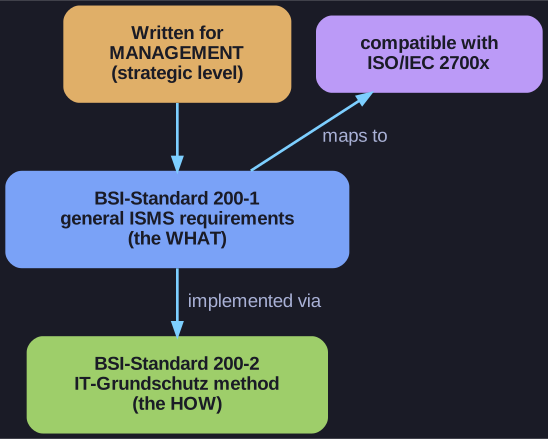
* 200-1 is the management-facing what; its sibling 200-2 is the practical how, and both stay ISO 27001-compatible. *
200-1 is the BSI's direct counterpart to ISO 27001: the top-level document that says what an ISMS must contain without yet getting into the implementation mechanics (those come in 200-2). Its design choice is what distinguishes it — it is written deliberately for management and in plain, well-explained language, where ISO 27001 is terse and abstract. So if your audience reads German and isn't contractually bound to an ISO certificate, 200-1 is usually the easier sell, because a board member can actually read it. And because it was built to be compatible with the ISO 2700x series, choosing 200-1 doesn't lock you out of ISO 27001 later — a 200-1 ISMS can pass an ISO 27001 audit with comparatively little extra work.
- Zielgruppe: Management; defines allgemeine Anforderungen for an ISMS.
- Draws on recommendations from ISO/IEC 13335 (older risk-management guidance) and ISO/IEC 27002 (controls).
- Includes explicit Hinweise on the interplay between security management and Datenschutz (privacy) — a real concern in German/EU practice.
- Free download from bsi.bund.de (BSI_Standards/standard_200_1.pdf).
Tip: Read 200-1 as the German cousin of ISO 27001 — but note the labour split: 200-1 is the what (general ISMS requirements), and its sibling 200-2 is the how (the practical IT-Grundschutz method). ISO bundles less hand-holding into the certifiable standard itself.
Go deeper:
 BSI-Standards overview (official, DE) — 200-1 defines general ISMS requirements and is ISO 27001-compatible.
- ISO/IEC 27001 (Wikipedia) — the standard 200-1 mirrors, useful for the what-vs-how comparison.