What is CSMA/CA and how does it differ from CSMA/CD?
CSMA/CA (Collision Avoidance) reserves the channel in advance to prevent collisions; CSMA/CD (Collision Detection) instead detects collisions after they happen and recovers.
CSMA/CA is the contention method used by Wi-Fi (IEEE 802.11 wireless LANs). The reason it avoids rather than detects collisions is physical: a wireless radio generally cannot listen for a collision while it is transmitting (its own signal drowns out everything), and two distant stations may not even hear each other — the hidden-node problem. So instead of recovering from collisions like CSMA/CD, each station announces up front how long its transmission will take; every other station notes that the channel is reserved and holds off until it is free. By coordinating before sending rather than reacting after a crash, CSMA/CA sidesteps collisions it could not reliably detect.
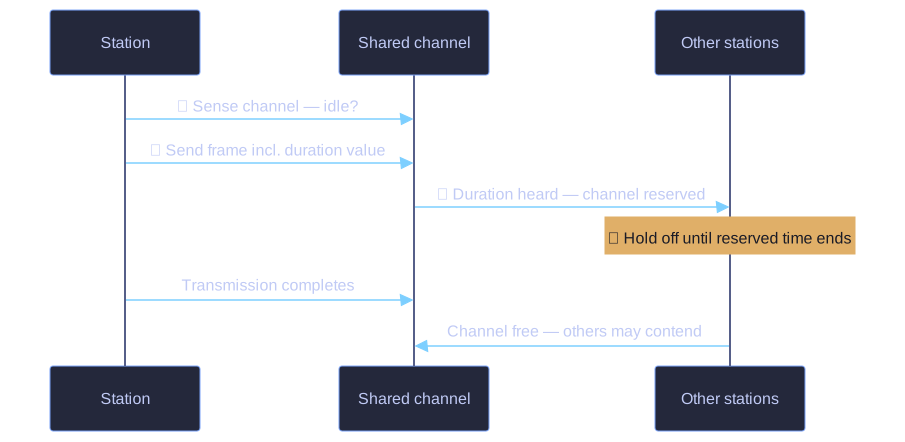
* CSMA/CA: a station advertises its transmission duration up front so others hold off, avoiding collisions before they happen. *
CSMA/CA = Carrier Sense Multiple Access with Collision Avoidance
Characteristics:
- Used by IEEE 802.11 WLANs (Wi-Fi)
- Operates in half-duplex mode
- Uses a collision avoidance process instead of detection
Collision avoidance process:
- When transmitting, devices include the time duration needed for the transmission
- Other devices on the shared medium receive this information
- Other devices know how long the medium will be unavailable and wait
Key difference: CSMA/CA prevents collisions by reserving the channel; CSMA/CD detects and recovers from collisions.
Go deeper:
 Wireless Contention — CSMA/CA, DCF, NAV (How I WiFi) — deepest source: DCF internals, virtual carrier sense / NAV, Duration/ID reservation, backoff and IFS.
- Collision Avoidance / CSMA/CA (NetworkAcademy.IO) — CCNA-level: the per-frame duration value that reserves the channel, and wireless avoid-before vs wired detect-after.
- CSMA/CA (Wikipedia) — avoidance vs detection, 802.11 usage, RTS/CTS channel reservation, and the hidden-node motivation.