What is differential privacy, and why is it stronger than k-anonymity and l-diversity?
Differential privacy adds mathematically calibrated noise so the output is essentially the same whether or not any one person is included — giving provable guarantees even against attackers with arbitrary background knowledge.
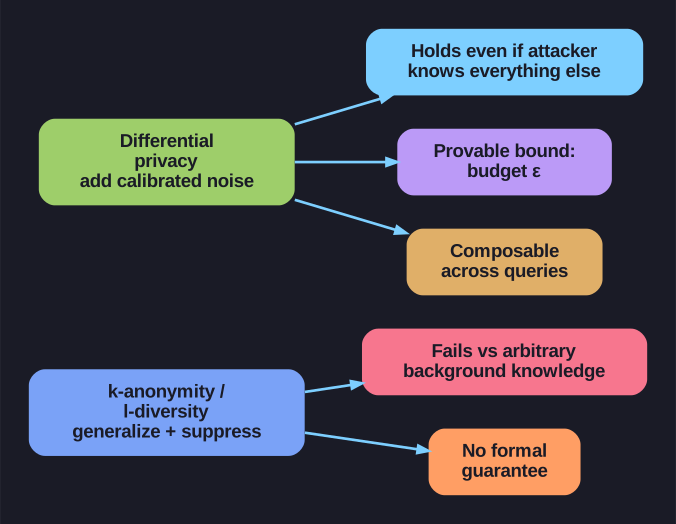
* Why differential privacy beats the k-anonymity family. *
Differential privacy (DP) is a paradigm shift: instead of generalizing a released table, it adds carefully calibrated statistical noise to data or query results. The defining property: an algorithm's output looks essentially identical whether any single individual's data is included or excluded — so participation can't be detected.
Why it beats k-anonymity/l-diversity:
- Provable, mathematical guarantees controlled by a privacy budget epsilon (ε) (smaller ε = more privacy, more noise).
- Plausible deniability for any individual's participation.
- Resistant to auxiliary-information (background-knowledge) attacks — the guarantee holds even if the attacker knows everything else.
- Composable — privacy loss across multiple queries adds up predictably.
Unlike k-anonymity and l-diversity, DP offers provable protection even when attackers possess arbitrary background knowledge — exactly the assumption those older models can't handle.
Tip: k-anonymity protects against the attacks you imagined; differential privacy protects against attackers who know more than you imagined.
Go deeper:
 Differential privacy (Wikipedia) — the rigorous framework, privacy budget and guarantees against arbitrary background knowledge.