Quiz Entry - updated: 2026.07.30
What is Duplicate Address Detection (DAD) in ICMPv6?
Before using an IPv6 address, a device sends an NS targeting that very address; if a neighbor already uses it, that neighbor replies with an NA. No reply means the address is unique and safe to use.
Duplicate Address Detection (DAD):
A process used in IPv6 to ensure an address is unique before using it.
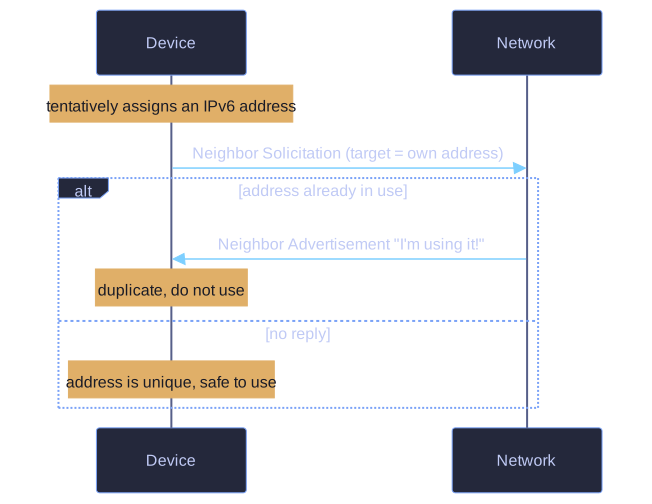
* The device probes its own tentative address with an NS — a returned NA means someone else has it, while silence means it is safe to use. *
How DAD Works:
Device                          Network
   │                               │
   │─── NS (target: own address) ─→│  "Anyone using this address?"
   │                               │
   │←── NA (if duplicate) ─────────│  "Yes, I'm using it!"
   │                               │
Process:
- Device assigns itself an IPv6 address (GUA or LLA)
- Device sends Neighbor Solicitation (NS) with its own address as target
- If another device has that address, it responds with Neighbor Advertisement (NA)
- No response = Address is unique, safe to use
- Response received = Duplicate! Don't use that address
When DAD is performed:
- When a new IPv6 address is configured
- Applies to both Global Unicast (GUA) and Link-Local (LLA) addresses
- DAD is not required, but RFC 4861 recommends DAD on unicast addresses
Key insight: DAD prevents IP address conflicts on IPv6 networks, similar to gratuitous ARP in IPv4.
Go deeper:
 RFC 4861 — Neighbor Discovery for IP version 6 (IPv6) — specifies Duplicate Address Detection and recommends it on unicast addresses.
- Neighbor Discovery Protocol — Wikipedia — DAD among the autoconfiguration safeguards of NDP.