What is EPS-AKA, the LTE authentication mechanism, and what is notable about its security?
EPS-AKA (Evolved Packet System Authentication and Key Agreement) is LTE's challenge-response authentication, derived from 3G's EAP-AKA within the EAP framework. It produces the cryptographic keys for call encryption after the protocol completes — but a reported attack affects all AKA variants, including 5G.
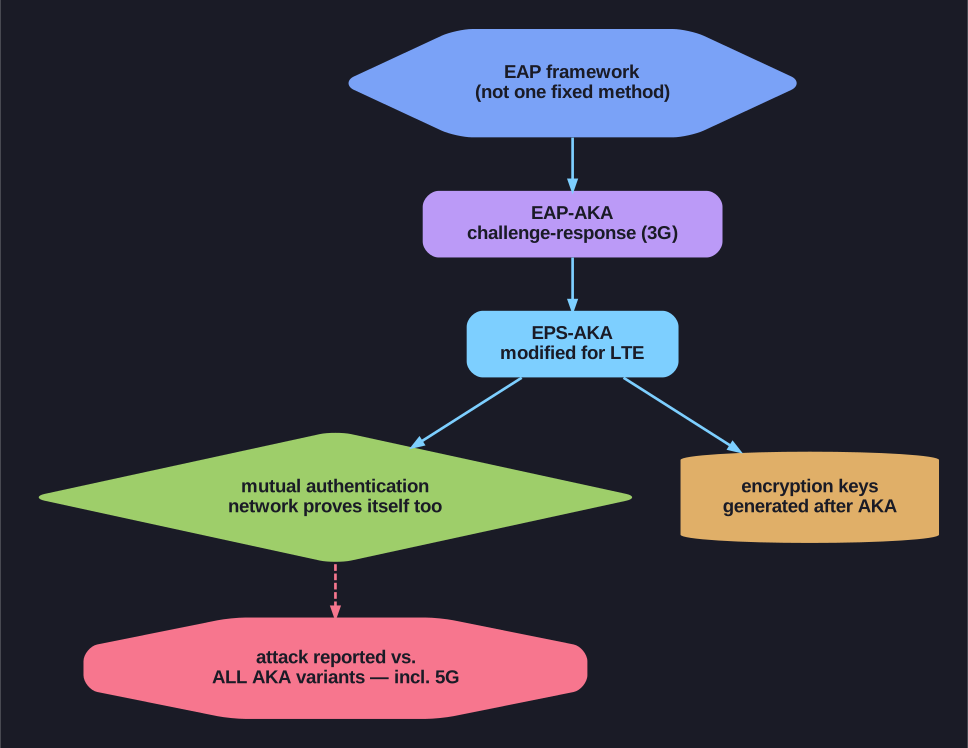
* EPS-AKA lineage: mutual authentication and post-protocol keys. *
The lineage:
- LTE uses the EAP (Extensible Authentication Protocol) framework — not one fixed mechanism
- EAP-AKA is one EAP method, using the Authentication and Key Agreement (AKA) mechanism, based on challenge-response
- EAP-AKA was used in 3G, then modified for LTE as EPS-AKA
- The keys needed to encrypt calls are generated after the AKA protocol completes
The spec (3GPP TS 33.401 – 6.1.1): EPS-AKA is the authentication and key-agreement procedure to be used over E-UTRAN.
The crucial security caveat: an attack has been reported against all variants of AKA, including 5G. So while AKA fixed GSM's biggest flaw — it provides mutual authentication (network proves itself too, killing the simple IMSI catcher) — it is not flawless. Research continues to find weaknesses even in the 5G version.
Tip: AKA's headline win over GSM is mutual authentication; its sobering caveat is that "newer" ≠ "unbreakable."
Go deeper:
 LTE Authentication (EPS-AKA) — ShareTechnote — a worked, step-by-step view of the AKA exchange: inputs (K, RAND, SQN, AMF), the Milenage outputs (RES, AUTN, CK, IK), and how mutual authentication is achieved.
- Authentication and Key Agreement (Wikipedia) — the challenge-response/mutual-authentication mechanism shared by UMTS, LTE and 5G, built on the shared key K.
- Extensible Authentication Protocol (Wikipedia) — the EAP framework that hosts EAP-AKA, the method LTE's EPS-AKA derives from.