What is equal-cost load balancing, and which routing protocol uniquely supports unequal-cost load balancing?
Equal-cost load balancing distributes traffic across multiple paths with the same metric — supported by all routing protocols and static routes. Only EIGRP (Enhanced Interior Gateway Routing Protocol) supports unequal-cost load balancing, distributing traffic proportionally across paths with different metrics.
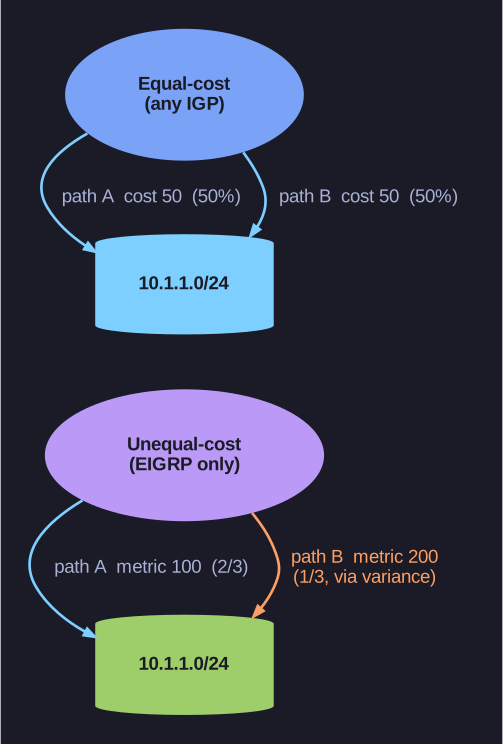
* Equal-cost vs EIGRP unequal-cost load balancing. *
Equal-Cost Load Balancing (ECMP):
- When two or more routes to the same destination have identical metrics, the router installs all of them
- Traffic is distributed across all equal-cost paths
- Increases bandwidth and redundancy simultaneously
- Enabled automatically by all dynamic routing protocols
- Also works with static routes: configure multiple static routes to the same destination via different next-hops
Example:
O 10.1.1.0/24 [110/50] via 10.0.0.2, Serial0/0    ← Path 1 (cost 50)
O 10.1.1.0/24 [110/50] via 10.0.0.6, Serial0/1    ← Path 2 (cost 50)
Both paths have cost 50 → traffic is split 50/50 between them.
Unequal-Cost Load Balancing (EIGRP only):
- EIGRP can distribute traffic across paths with different metrics
- Traffic is distributed proportionally — the better path gets more traffic
- Configured using the
variancecommand - Example: Path A has metric 100, Path B has metric 200 → Path A gets 2/3 of traffic, Path B gets 1/3
Why only EIGRP? EIGRP's DUAL algorithm maintains a "feasible successor" concept that allows it to mathematically guarantee loop-free alternate paths with different metrics. Other protocols can only guarantee loop-freedom for equal-cost paths.
Tip: ECMP is one of the most powerful features for increasing bandwidth without upgrading links — two 1 Gbps links with ECMP effectively give you 2 Gbps aggregate throughput.
Go deeper:
 Equal-cost multi-path routing (Wikipedia) — ECMP mechanics plus the flow-hashing that avoids reordering.