What is federated learning, and how does it preserve privacy?
A way to train a shared machine-learning model across many parties where each trains locally on its own data and only model updates (not raw data) are sent and aggregated.
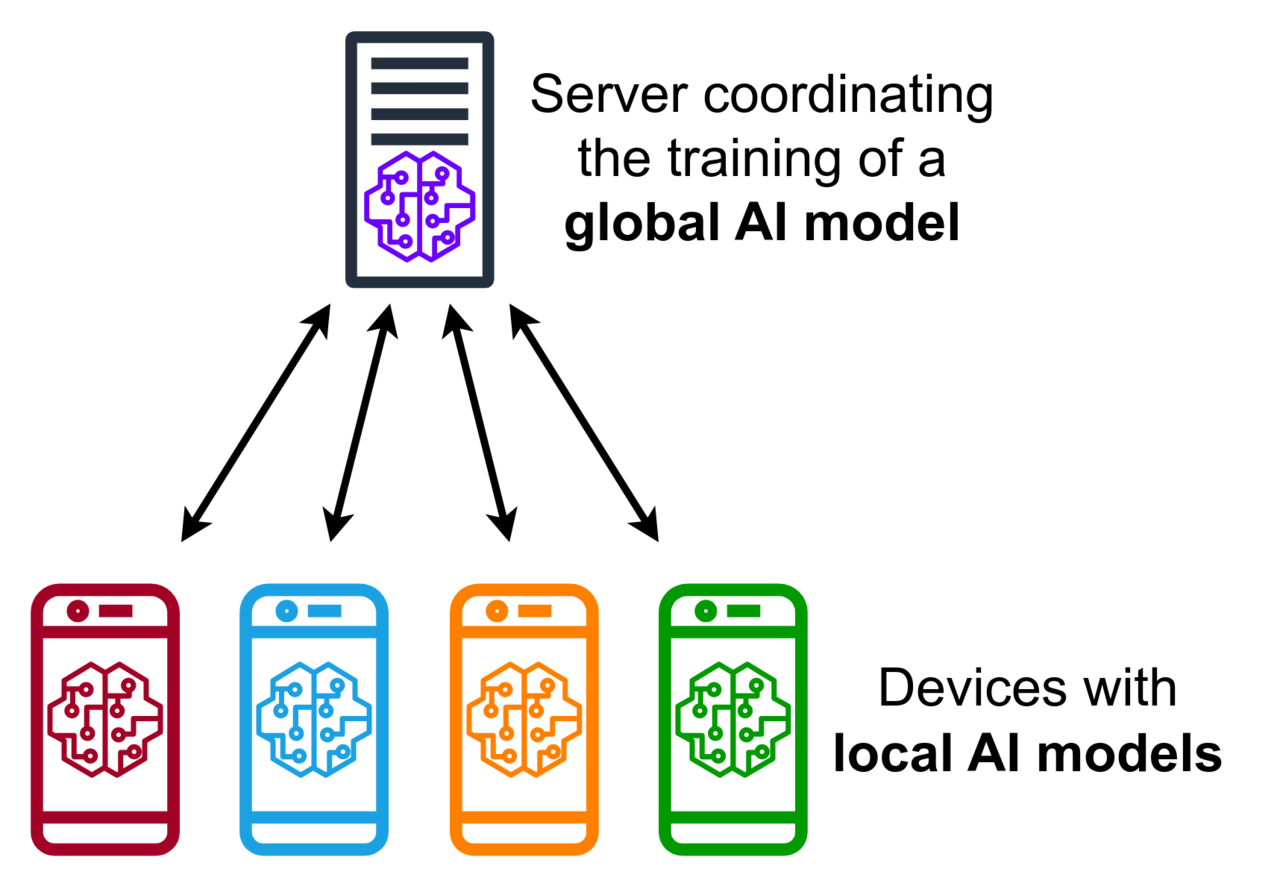
* Local training and update aggregation in federated learning. — MarcT0K, CC BY-SA 4.0, via Wikimedia Commons. *
The four-step cycle:
- Local training — each node trains on its own data, which never leaves the device/org.
- Update sharing — only model parameters/gradients are sent to a central server.
- Aggregation — the server combines the updates into an improved global model.
- Distribution — the improved model is sent back to the nodes, and the cycle repeats.
Why it helps privacy: raw data stays put, dramatically reducing leakage risk in distributed settings while still enabling powerful collaborative analytics (e.g. training a keyboard predictor across millions of phones).
Caveat: updates can still leak information (gradient-inversion attacks), so federated learning is often combined with differential privacy or secure aggregation.
Go deeper:
 Federated learning (Wikipedia) — centralized vs decentralized protocols and the gradient-leakage caveat.